
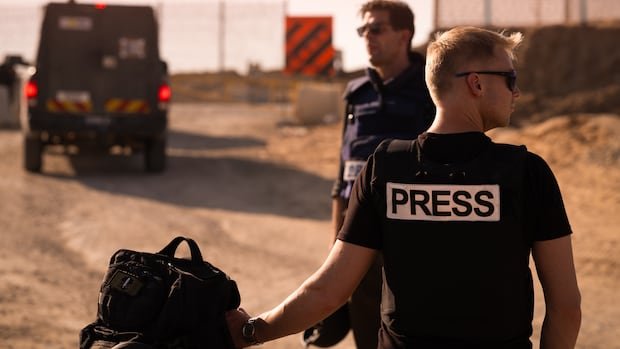
At the southern edge of Gaza’s border with Israel lies a conflict zone. Dusty paths cut through a desolate desert near the Egyptian border. Israeli soldiers stationed at the checkpoint seem uninterested, cautioning against capturing their images. A group of reporters, equipped with cameras and clad in protective gear, including bulletproof vests and helmets, are transported in humvees to a parking area around 200 meters away. For two years, the sole method for foreign journalists to enter Gaza authorized by the Israeli military is through escorted visits or temporary embedding. Despite numerous appeals by media outlets like CBC News for more unrestricted entry, all requests have been denied.
However, on this particular day, in response to international pressure from various organizations and governments, Israel aims to clarify why aid might not be reaching the starving Palestinians in Gaza. A spokesperson for COGAT, Israel’s aid distribution agency, disclosed that the delay in aid delivery is due to awaiting UN actions, not Israel’s negligence. Despite allowing nearly 300 aid truckloads daily, the aid items often remain untouched for weeks.
The scene at the parking lot includes bags of rice, cans of fish, and crates marked with UNICEF, Red Cross, and World Food Program labels, left under the scorching sun. The UN attributes the aid delay to stringent bureaucratic regulations imposed by Israel on imports and inadequate security provision along patrolled Gaza roads. Olga Cherevko from the UN’s OCHA distribution agency highlighted the significant obstacles hindering access as the primary challenge faced.
The issue of restricted access extends to the media, with Israel citing safety concerns as a reason for preventing independent journalists from entering Gaza. Efforts by the Foreign Press Association to secure entry through Israel’s Supreme Court were rejected on security grounds. The absence of independent observers has raised questions about the reported widespread starvation in Gaza and the conflicting accounts from different sources. The lack of foreign reporters has left some Palestinians feeling neglected and unseen amidst the conflict.
Local journalists have assumed the role of reporting the crisis to the world, with many risking their lives to document the unfolding events in Gaza. The UN reported a staggering 247 journalist deaths since October 7, 2023, labeling it as the deadliest conflict for journalists in nearly three decades. The hostile environment has led to accusations of targeted attacks on journalists by Israel, with claims of working for Hamas used as a pretext for violence.
The limited media coverage from both Israeli and international sources has sparked debates about the portrayal of events in Gaza and the public’s perception of the conflict. The Israeli media’s nationalist stance and selective reporting have shaped public opinion, with a significant portion of the population unaware of the broader context and suffering in Gaza. The disconnect between global outrage and local understanding underscores the challenges of accessing unbiased information in the midst of a complex and deeply entrenched conflict.

