
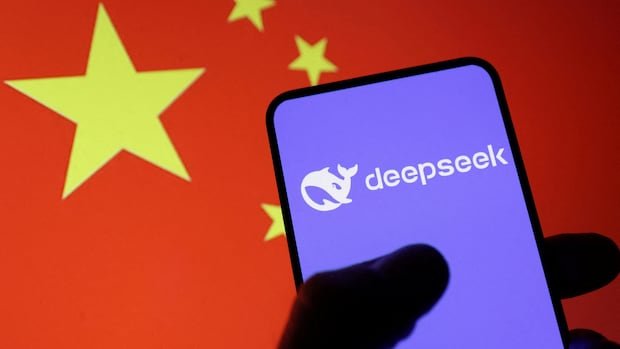
A Beijing-based company has unveiled China’s most advanced artificial intelligence model to date, bringing the nation closer to the U.S. in a competition likened to a modern-day cold war. Kimi K2 Thinking, developed by Moonshot AI, is a generative chatbot powered by AI, similar to OpenAI’s ChatGPT and Anthropic’s Claude.
According to Michael Deng, a technology analyst at Bloomberg, Kimi K2 Thinking has made significant strides in matching the performance of U.S. and Western models since the introduction of Deepseek in January, which had caused market turbulence due to concerns over China’s AI progress. Kimi K2’s success on Humanity’s Last Exam, a rigorous 2,500-question benchmark that evaluates an AI’s reasoning skills, positioned it just below recent ChatGPT models, outperforming both Claude 4.5 and Meta’s Llama.
While the U.S. maintains a lead in AI, experts note that China’s advancements are narrowing the gap. Some North American companies and consumers are opting for Chinese AI technologies, highlighting China’s technical prowess that rivals top U.S. innovations. Chinese-made AI models offer cost-effective and customizable solutions, attracting companies like Airbnb and venture capital firm Social Capital, which have shifted their operations to Chinese models due to their efficiency and affordability.
Despite the competitive landscape, analysts predict that Chinese AI models are unlikely to dominate the market soon. However, they will continue to exert pressure on U.S. models, influencing AI pricing. The race to enhance AI capabilities is viewed by some as a potential precursor to real-world conflicts, with AI seen as a critical technology akin to atomic weapons or the space race, impacting economic and national security.
Various perspectives exist on the implications of AI dominance, with concerns raised about surveillance and coercion in a state-controlled AI environment versus a technology anchored in values of liberty and human dignity. Cultural biases and political influences demonstrated by AI systems from both countries underscore the complexities of AI development and deployment.
Both the U.S. and China possess unique strengths and limitations in the AI race. China has emerged as a significant player in electrical capacity, crucial for powering AI advancements. However, U.S. export controls on semiconductor chips have hindered China’s infrastructure development, limiting its capabilities compared to the U.S. The two nations approach AI technology differently, with Silicon Valley aiming for comprehensive solutions across various sectors, while China focuses on integrating AI into industrial and technological processes.
The evolving AI landscape reflects a diverse approach to technology development, with the potential for significant impacts on society. The ongoing competition highlights the importance of values and ethics in shaping the future of AI technologies.

