
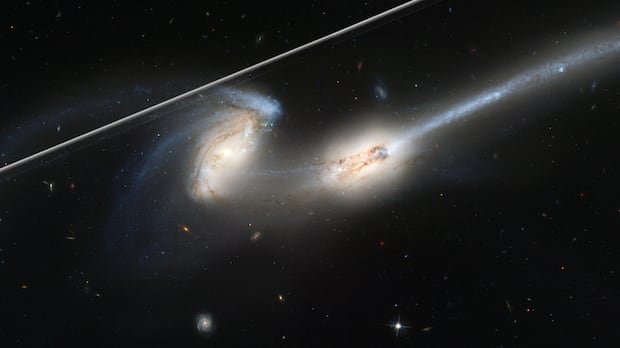
Satellite constellations, groups of multiple satellites ranging from a few dozen to tens of thousands, are causing disruptions to scientific studies conducted using ground-based telescopes. A new study now examines the potential impact of these constellations on space-based telescopes like the renowned Hubble Space Telescope.
The Hubble Space Telescope has not only captured stunning images of galaxies and nebulas but has also been pivotal in significant scientific breakthroughs, such as determining the rate of the universe’s expansion.
However, the scientific endeavors of these telescopes could be jeopardized if the proposed satellite megaconstellations, involving thousands of satellites launched by companies like SpaceX and Amazon, proceed as planned.
The study, recently published in Nature, focused on analyzing the effects on Hubble, NASA’s SPHEREx, the European Space Agency’s proposed ARRAKIHS, and China’s planned Xuntian telescope. The research estimates that if around 560,000 satellites are launched into orbit over the next decade, approximately 39.6% of Hubble’s images would be impacted, while the other three telescopes would face a 96% interference rate.
As satellites traverse the sky, they leave long streaks of light across telescope images, disrupting observations. Additionally, their electromagnetic radiation emissions in low frequencies can interfere with radio astronomy.
The authors of the study noted an average of 2.14 satellites visible per exposure for Hubble, 5.64 for SPHEREx, 69 for ARRAKIHS, and 92 for Xuntian. Lead author Alex Borlaff, a NASA research scientist, highlighted the increasing frequency of satellite appearances in telescope views, emphasizing the escalating challenge this poses to astronomical research.
The surge in satellite numbers, from around 2,000 in 2019 to approximately 15,000 presently, primarily driven by initiatives like SpaceX’s Starlink and Amazon’s Kuiper constellation, is aimed at enhancing global internet connectivity. Despite the benefits, the proliferation of satellites raises concerns about their impact on scientific observations and celestial research.
While ground-based observatories can adjust their operations to avoid satellite interference, space-based telescopes face greater difficulties in mitigating such disruptions. The study underscores the urgency of addressing these issues as megaconstellations expand.
Moreover, potential consequences extend beyond scientific research, impacting our cultural connection to the night sky and raising environmental and navigational concerns. Addressing these challenges will require a balanced approach to ensure the coexistence of satellite technologies and astronomical pursuits.

