
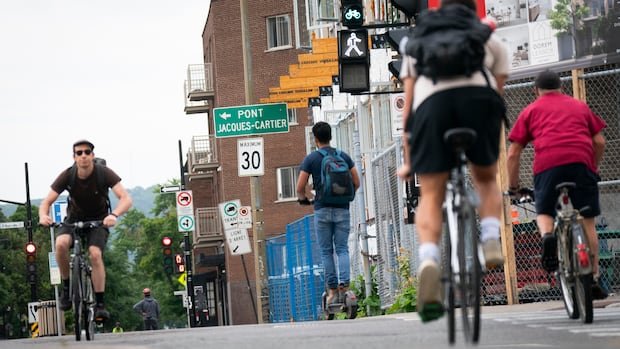
Since Valérie Plante became Montreal’s Mayor in 2017, the city’s cycling infrastructure has expanded by 35%, adding 280 kilometers of bike paths. Currently, Montreal boasts 1,082 kilometers of cycling routes. Some residents argue that there might be an oversaturation of bike lanes, with certain mayoral candidates leveraging discontent with cycling infrastructure for political gain. However, in 2025, during a time of heightened concern over climate change, the debate between bikes and cars is deemed misleading, leading to similar stances among candidates on bike paths.
Before delving into the campaign promises regarding cycling made by the five mayoral contenders, it’s essential to understand the impact of bike paths on on-street parking and businesses. The allocation of space for bike infrastructure versus car usage is lopsided, with only 2.3% of Montreal’s roadways dedicated to biking, contrasting with nearly 98% designated for cars, as highlighted in a 2025 study by McGill University’s Platial Analysis Lab.
According to Kevin Manaugh, an associate professor at McGill University, the trade-offs involved in building bike lanes, even at the expense of car parking, are necessary for creating healthier and more environmentally friendly cities. Despite concerns raised about the reduction in parking spaces due to bike paths, research suggests that the benefits of improved bike infrastructure outweigh the costs for businesses, particularly in retail and food services.
Moreover, it is noted that the shortage of public roadway in Montreal affects all commuters, not just cyclists. Data from Eco-Counter and the City of Montreal reveal significant bike usage, with certain intersections seeing over a million bike counts annually. This underscores the inefficiency of dedicating considerable space to parked cars in congested urban areas.
In response to the ongoing debate, Montreal has repurposed a fraction of on-street parking spots to enhance pedestrian safety and develop the Réseau Express Vélo (REV), a citywide cycling network. However, for individuals reliant on cars for transportation, the transition to cycling may not be straightforward without viable alternatives.
Regarding the impact on businesses, studies suggest that while improved bike infrastructure generally benefits retail and food services, it may adversely affect car-centric establishments. The long-term benefits of bike paths, such as enhanced economic activity and street appeal, are evident in areas like St-Denis Street, where initial resistance from businesses gave way to positive outcomes.
As the municipal election approaches, mayoral candidates are outlining their strategies related to cycling infrastructure. From expanding the cycling network to reassessing current bike paths, candidates are positioning themselves on various approaches to promote cycling. Each candidate brings a unique perspective, with proposals ranging from enhancing bicycle-sharing services to prioritizing public safety and health through innovative bike infrastructure solutions.
In conclusion, the discourse surrounding bike paths in Montreal reflects a broader societal shift towards sustainable urban development. As the city navigates the complexities of balancing diverse transportation needs and environmental considerations, the future of cycling infrastructure will play a crucial role in shaping Montreal’s urban landscape.

