
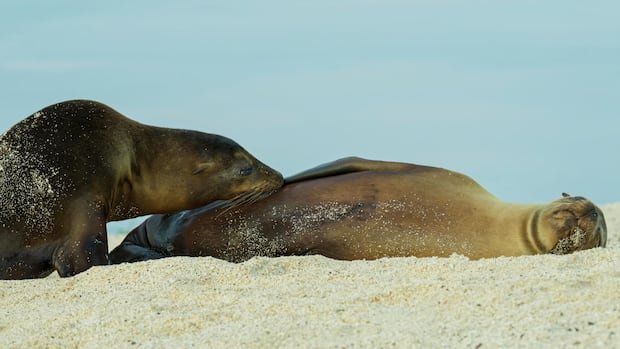
A recent study led by Alexandra Childs, a PhD candidate in marine biology at the University of Bielefeld in Germany, sheds light on a fascinating behavior observed among fully grown Galápagos sea lions. The study, published in the American Naturalist journal, reveals that approximately 11% of the sea lion population in the Galápagos Islands continues to nurse from their mothers well into adulthood, a phenomenon referred to as “supersuckling.”
Childs expressed astonishment at witnessing these sea lions engaging in prolonged nursing, comparing it to humans breastfeeding into their teens or twenties. The study, based on 20 years of data on Galápagos sea lions (scientifically known as Zalophus wollebaeki), highlights that most sea lions typically wean from their mothers between 1.5 and 4.5 years of age. However, supersucklers defy this norm by persisting in nursing beyond the expected age range.
Notably, the study documents instances of multigenerational nursing trains, where sea lions of different generations engage in nursing simultaneously. While this behavior has been observed in other sea lion species and seals, the extent to which it occurs in Galápagos sea lions is particularly pronounced.
According to Andrew Trites, director of the Marine Mammal Research Unit at the University of British Columbia, supersuckling behavior is often linked to food scarcity in other species. However, the study suggests that in the Galápagos context, supersuckling may occur more frequently during periods of abundant food resources rather than scarcity.
While the exact reasons behind this behavior remain unclear, researchers speculate that it could serve as a bonding mechanism or convey some immunological or social benefits. Further research is needed to unravel the intricacies of this unique phenomenon observed in Galápagos sea lions.
Childs emphasized the importance of continued research to deepen our understanding of this behavior, as her own fieldwork on the island has concluded. She expressed hope for future studies conducted by upcoming researchers to shed more light on the mysteries surrounding supersuckling in Galápagos sea lions.

