
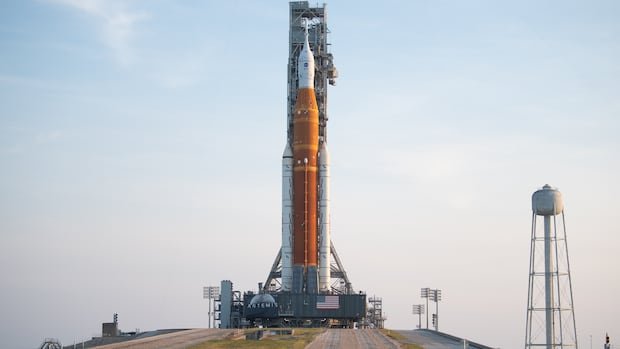
After a hiatus of 52 years, humanity is once again gearing up to visit the moon. NASA’s ambitious Artemis program is making strides with Artemis II, a mission that will see four astronauts – including Canadian Space Agency astronaut Jeremy Hansen and NASA astronauts Christina Koch, Reid Wiseman, and Victor Glover – orbiting the moon. The launch is tentatively set for February 6.
Before the astronauts embark on this historic journey, the rocket and spacecraft must undergo thorough checks. The colossal 100-meter-tall Space Launch System (SLS) is poised for rollout on Saturday, a moment eagerly anticipated by John Honeycutt, the Artemis II mission management team chair.
The SLS and the Orion spacecraft, the astronauts’ home for 10 days, have only been launched once on the uncrewed Artemis I mission around the moon in 2022. Now, they are set for human passengers. While the crew won’t touch down on the lunar surface, they will engage in lunar surveillance, experiments, and spacecraft testing in preparation for Artemis III, where astronauts are slated to walk on the moon, tentatively in 2028.
The rollout on Saturday is scheduled for 7 a.m. ET, with the massive rocket expected to take eight to 12 hours to reach the launch pad. The crew access arm will be retracted, a process taking approximately 45 minutes. Once at the pad, connections will be established over the following day. The wet dress rehearsal, loading the rocket with propellant as if it were launch day, will follow, ensuring a meticulous preparation process before the actual launch.
Wet dress rehearsals are crucial practice sessions, necessitating near-perfection before the green light for launch is given. Artemis I underwent four such rehearsals over several months before getting clearance for launch. Reflecting on the proximity of the Feb. 2 wet dress rehearsal to the Feb. 6 launch window, Charlie Blackwell-Thompson emphasized the valuable lessons learned from Artemis I’s testing phase.

