
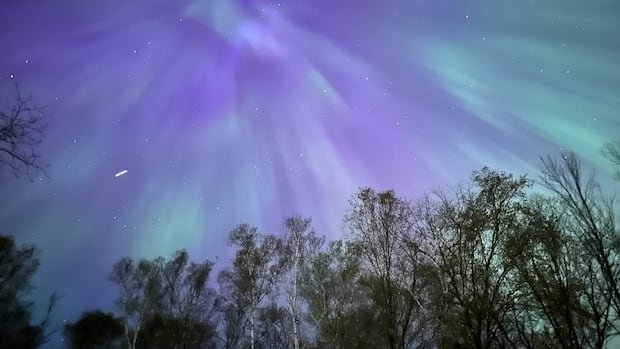
On Monday night, individuals with clear skies have the chance to witness a noteworthy display of the northern lights. The U.S. Space Weather Prediction Center reported that a powerful X 1.9 flare from the sun, followed by a coronal mass ejection (CME), occurred. This flare was extraordinary as it lasted for several hours, making it more impactful than flares of similar magnitude.
CMEs are solar explosions that release particles at a heightened speed, affecting Earth’s magnetic field and potentially creating the mesmerizing aurora borealis in the northern hemisphere and aurora australis in the southern hemisphere. Fortunately, Earth was in the trajectory of this recent CME.
The SWPC forecasts the CME to reach Earth between late January 19 and early January 20 EST. This event is expected to lead to a severe geomagnetic storm, classified as a G4 storm on the scale, indicating its severity.
In the past, geomagnetic storms of a higher magnitude like G5 have produced stunning light displays visible as far south as the Caribbean. While the northern lights are typically observed in northern regions, favorable conditions such as Earth’s alignment with the CME’s particle stream and dark skies can extend visibility further south.
To increase chances of witnessing this phenomenon, viewers are advised to seek dark and cloud-free locations. Utilizing apps like Aurora Alerts and Aurora Forecast can help individuals track the visibility of the aurora borealis in their specific locations.

