
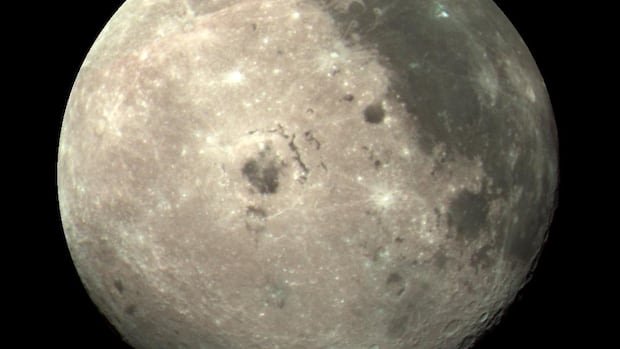
When Canadian astronaut Jeremy Hansen embarks on the Artemis 2 mission, he will have the unique task of observing the far side of the moon, a region unseen from Earth. Simultaneously, scientists on Earth are preparing to send telescopes and robots to explore this mysterious lunar area.
The moon, being gravitationally locked to Earth, consistently presents only one side to our planet while the other side faces deep space. Despite commonly being referred to as the “dark side,” this nickname is misleading as the far side receives an equal amount of sunlight compared to the visible side.
Distinguished by its rough, crater-dense terrain unlike the smoother near side with its expansive flat plains known as “Maria,” the far side of the moon offers a serene environment shielded from Earth’s artificial radio interference, making it an alluring location for astronomers to set up radio telescopes.
Accessing the far side of the moon is only possible via spacecraft, granting Hansen a rare opportunity to witness sights unseen by most humans since the Apollo era. Unlike the Apollo missions that orbited close to the equatorial regions, Hansen’s trajectory on Artemis will take him 7,500 kilometers beyond the moon, allowing a panoramic view of the entire Earth.
During the Artemis flyby, the crew will closely observe the lunar surface, utilizing the human eye’s ability to discern subtle details crucial for future spacecraft landings, such as variations in color and texture that may affect landing conditions.
A proposed mission to the far side involves the TSUKUYOMI, a Lunar Meter Wave Telescope intended to deploy radio dishes on the lunar far side to probe the universe’s early dark ages. By detecting faint radio signals from neutral hydrogen gas that existed before stars and galaxies, researchers hope to unlock the mysteries surrounding dark matter’s influence on the universe’s evolution.
Further plans include deploying additional radio observatories like LuSEE Night and NASA’s Farside Seismic Suite to study the moon’s far side. NASA and ESA are also in the early stages of developing lunar observatories for future exploration.
While human moon missions prioritize establishing colonies and investigating water ice near the south pole, landing sites will maintain a direct line of sight with Earth for communication purposes. Meanwhile, on the hidden far side of the moon, a multitude of robots will silently explore the cosmos, unraveling the universe’s origins.
[End of rewritten article]

