
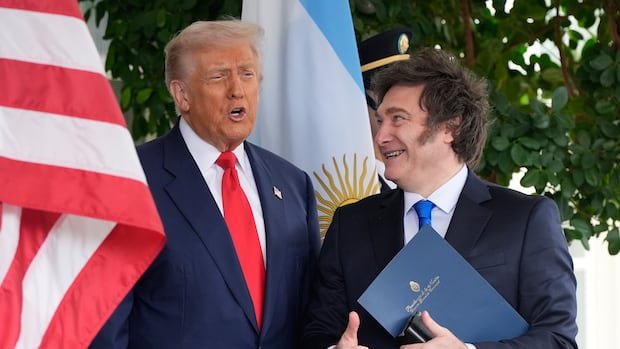
President Donald Trump stated that U.S. assistance to Argentina depends on the success of President Javier Milei’s ruling party in the upcoming midterm legislative elections. Trump emphasized the importance of Milei’s party winning, indicating that support would be contingent on this outcome.
Following a recent agreement for financial aid to Argentina, Trump met with Milei at the White House. Expressing confidence in Milei’s philosophy and potential victory, Trump highlighted the significance of Milei’s success for continued support from the U.S. government.
The financial aid package, which includes a $20 billion currency swap with Argentina’s central bank, was announced by U.S. Treasury Secretary Scott Bessent. The potential impact of Milei’s electoral performance on U.S.-Argentina relations led to fluctuations in the Argentine markets, with stock market indices showing a decline after Trump’s remarks.
The details of the support package, which are yet to be fully disclosed, are said to be based on the alignment of economic policies with those favored by the Trump administration. This assistance could offer Milei’s party a boost as they navigate economic challenges and seek to strengthen their position ahead of the legislative elections on October 26.
The decision to provide aid to Argentina represents a departure from the Trump administration’s approach of reducing foreign interventions. While facing criticisms domestically for prioritizing foreign assistance over domestic issues, such as the partial government shutdown, this move underscores the administration’s commitment to supporting allies with whom strong ties have been cultivated.
Critics, including Democratic lawmakers and American farmers, have raised concerns about the impact of U.S. policies on domestic industries, particularly in light of shifting trade dynamics with countries like China. The assistance to Argentina has sparked debates about the administration’s foreign policy priorities and its implications for various sectors within the U.S. economy.
Despite the strategic considerations underlying the aid package, Trump acknowledged that the U.S. was not obligated to provide such support. This stance reflects a broader approach to international relations that balances national interests with external commitments.

