
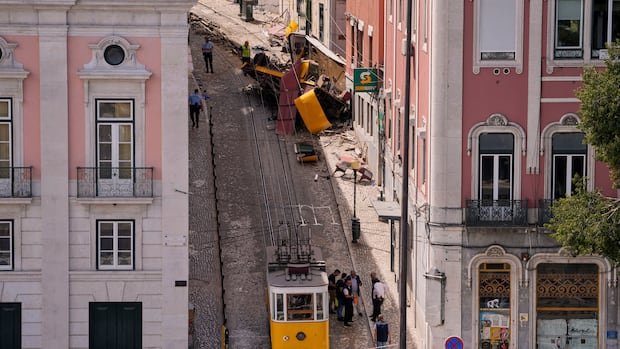
The recent fatal streetcar accident in Lisbon, Portugal, which claimed the lives of 16 individuals, including three Canadians, was caused by a combination of a steel cable failure and maintenance deficiencies, as revealed in an official preliminary report released on Monday.
The incident, considered one of Lisbon’s most tragic events in recent history, involved a century-old streetcar known as a funicular, operating on a steep hill alongside another car, offering a popular tourist attraction in the city. The streetcar lost control while descending the hill, veered off the tracks on a curve, and collided with a building, resulting in severe damage to the wooden cabin. Among the fatalities, 11 were foreigners, including individuals from Quebec and Ottawa, Canada.
According to the preliminary report by the Office for Air and Rail Accident Prevention and Investigation, the steel haulage cable connecting the two streetcars for weight distribution was not adequately robust for the task. The cable lacked certification for public transportation and was not installed in compliance with the manufacturer’s guidelines, despite being in service for less than a year.
The investigation also uncovered deficiencies in the maintenance program, citing instances of outdated or irrelevant standards. Following the cable failure, safety mechanisms disengaged the power supply to the streetcar, rendering the pneumatic brake ineffective and the manual brake insufficient to halt the vehicle’s descent down the hill. Authorities are now examining the necessity of enhancing streetcar brake systems.
While the preliminary report does not assign fault or determine liability, a comprehensive final report is anticipated next year, providing a more thorough analysis of the tragic accident.

