
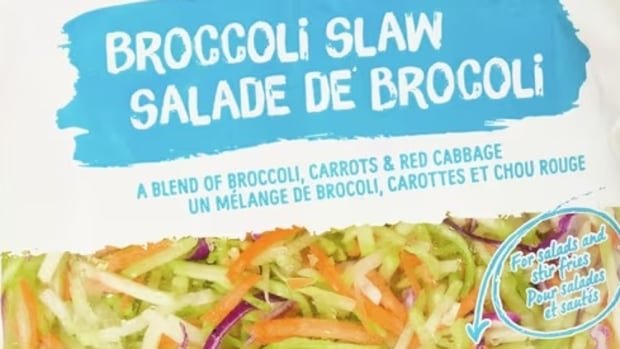
The Canadian Food Inspection Agency (CFIA) has shared additional information with CBC News regarding the $10,000 penalty imposed on a Loblaw-owned Superstore last month for marketing imported food as Canadian. The mislabeled product in question was President’s Choice broccoli slaw, a Loblaw-owned brand that features shredded broccoli as a twist on coleslaw. The CFIA highlighted that a Toronto Superstore showcased the salad bags with “maple leaf advertising decals” and a “Product of Canada” statement on an in-store shelf tag, despite the packaging indicating “Product of USA.”
To qualify as “Product of Canada,” a food item must be predominantly or entirely produced in Canada, as outlined by the CFIA guidelines. Grocers have leveraged a growing buy-Canadian trend that emerged in response to trade tensions and remarks by U.S. President Donald Trump. They have utilized Canadian branding to promote locally sourced products in their stores. However, both the CFIA and CBC News have uncovered instances where major grocers have misrepresented imported food as having Canadian origins, a practice known as “maple washing.”
Following CBC’s investigation last summer, concerns were raised by shoppers over the absence of fines imposed by the CFIA on grocers violating labeling regulations. Federal rules mandate that food labels and in-store signage must be precise and not deceptive.
In a separate case involving Sobeys, the CFIA’s scrutiny of a mislabeling incident last April at a Safeway store near Edmonton found that Compliments avocado oil was advertised as “Made in Canada,” despite being an imported product. While Sobeys rectified the issue, the CFIA is still assessing potential further actions.
Notably, consumer feedback questioned the adequacy of the $10,000 fine levied on Loblaw, considering its substantial retail revenue. Suggestions emerged for heavier penalties, starting at $100,000, to deter grocers from misrepresenting foreign goods as Canadian. However, existing regulations limit CFIA penalties to a maximum of $15,000 per violation. Both Loblaw and Sobeys emphasized their commitment to accurate country-of-origin labeling, acknowledging the complexities associated with managing extensive inventory.

