
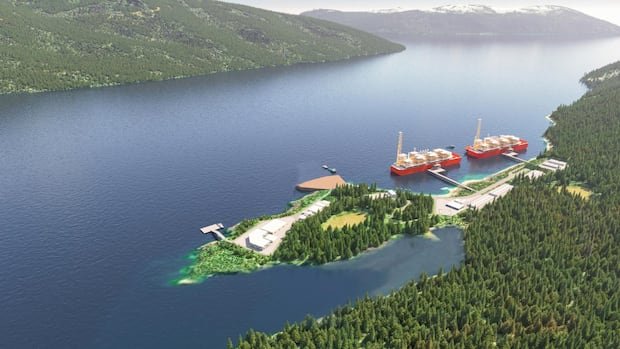
A second German energy company has shown interest in procuring liquefied natural gas from the Ksi Lisims project set to be developed on the northern coast of British Columbia. The project partners are nearing a final decision on moving forward with the initiative.
Uniper, headquartered in Duesseldorf, and Ksi Lisims LNG announced on Monday the signing of a letter of interest, indicating a potential purchase of two million tonnes of gas annually starting as early as 2032. The agreement sets out key commercial terms for a more concrete supply and purchase arrangement with Uniper, which primarily operates in Germany, the United Kingdom, Sweden, and the Netherlands.
With 18.5 gigawatts of power generation capacity, Uniper is a significant LNG importer in northwestern Europe. Following the 2022 energy crisis triggered by Russia’s invasion of Ukraine, the German government assumed control of Uniper but is now in the process of privatizing the company.
Uniper’s CEO, Michael Lewis, emphasized the importance of diversifying the company’s LNG supply portfolio, highlighting Canada’s appealing environment with abundant gas resources, stable political landscape, and reliable regulatory structures.
The Ksi Lisims project, led by Houston-based Western LNG in collaboration with Rockies LNG, a group of Canadian natural gas producers, and the Nisga’a Nation, aims to operate a floating LNG plant on Pearse Island near the Alaska border, capable of exporting up to 12 million tonnes of LNG annually.
Although the $10-billion project has secured regulatory approval, the partners have yet to make a final investment decision. Securing long-term supply agreements is a crucial step towards reaching this milestone.
Davis Thames, the CEO of Western LNG, noted that the project and Europe’s interest in it exemplify how energy security, environmental responsibility, and community-focused economic development can be achieved concurrently.
The signing of a long-term agreement by the German government-owned company SEFE for the purchase of one million tonnes of LNG annually from Ksi Lisims further underlines the shift in European gas sourcing away from Russia post the 2022 Ukraine crisis.
Cargo from Ksi Lisims could potentially reach Germany through various routes, including the Panama Canal or through swap deals with other companies closer to the destination. This move by Uniper and Ksi Lisims is perceived more as a strategic political maneuver in both Canada and Germany rather than a direct energy security initiative, as suggested by Alex Walker, an energy analytics program manager at Environmental Defence.
The Ksi Lisims project faces challenges from First Nations opposition and legal disputes surrounding the project and the associated pipeline. Despite ongoing developments, the project’s realization as a transformative nation-building endeavor is far from certain.

