

A recent study conducted by a biologist from Trent University indicates that Toronto must revise its strategy for managing coyotes, a suggestion that is causing concern among some animal advocates.
Dennis Murray, the primary author, argues that coyotes that repeatedly pose a problem ought to be put down. He believes the city takes too long to consider this action, hoping the troublesome coyote will vacate the area voluntarily.
Murray criticized the city’s approach, stating, “Currently, it feels like burying your head in the sand and wishing for the best,” referring to the city’s coyote coexistence and response strategy, which was ratified by the council last year.
Toronto has seen an increase in coyote-human interactions recently, especially in the downtown areas of Liberty Village and Fort York.
According to city data, since 2020, there have been nine recorded instances of coyote bites on humans in Toronto, and numerous dogs have also been attacked, with some resulting in fatalities.

Prof. Dennis Murray, of Trent University, asserts that his research compiles insights from various researchers and municipalities across North America. He concludes that municipalities often delay the euthanization of problematic animals due to a hope that the issue will resolve itself. (Zoom)
According to Mahreen Dasoo, a spokesperson for the city, “Historically, programs aimed at coyote removal in North America have proven to be costly, ineffective, and sometimes counterproductive.”
She added, “Removal fails to address the underlying issues that lead to conflicts between humans and misbehaving coyotes.”
While no human attacks have occurred in Toronto this year, three individuals were bitten by coyotes in the Greater Toronto Area last month, including a toddler in Whitby who sustained serious facial injuries.
Following a series of dog attacks in Liberty Village last year, the city identified four specific coyotes, two of which were euthanized. The remaining two coyotes subsequently left the area, according to a city release from May 2025.
A month later, the city finalized its revised coyote response strategy, which prioritizes public education regarding coyote behavior and aversion tactics.
The strategy outlines that aversion tactics, or hazing, involve actions such as waving colored garbage bags at approaching coyotes, shouting, clapping, using whistles, brandishing a cane, or tossing small objects like tennis balls or pebbles towards the animal.

A sign indicating recent coyote sightings is displayed on a fence surrounding a playground in a downtown park in Toronto. Raising public awareness of sightings is integral to the city’s coyote awareness initiative. (Mike Smee/CBC)
However, in his July 15 peer-reviewed paper published in the journal Frontiers in Ecology and Evolution, Murray contends that hazing often fails to keep coyotes at bay from pets and people.
He wrote, “Research indicates that hazing leads to measurable avoidance only when applied consistently and intensively in the early stages of habituation, and even then, the effects are usually short-lived.” This paper was co-authored with two members of the Coyote Safety Coalition, a community group in Liberty Village advocating for more aggressive coyote removal measures.
The study also criticizes municipalities for overly relying on a coexistence philosophy instead of prioritizing public safety.
Toronto’s updated coyote strategy includes a tiered system for addressing coyote sightings in urban areas, categorizing encounters from simple sightings to actual attacks on humans.
The approach encompasses a range of increasingly serious interactions, each with associated solutions.
If a coyote enters a person’s yard, staff recommend hazing as a response. In cases where a coyote pursues a human, the suggestion is to “install additional and/or customized coyote signage … consider offering public education sessions.”
Should a leashed pet be attacked, the city advises “proactive patrolling or educational visits and/or closure of a pathway or park.”
In the most severe instances, such as a human attack, the city’s strategy involves a comprehensive investigation, including determining whether the attack was provoked. Remedies may include euthanization or relocation to a wildlife sanctuary.
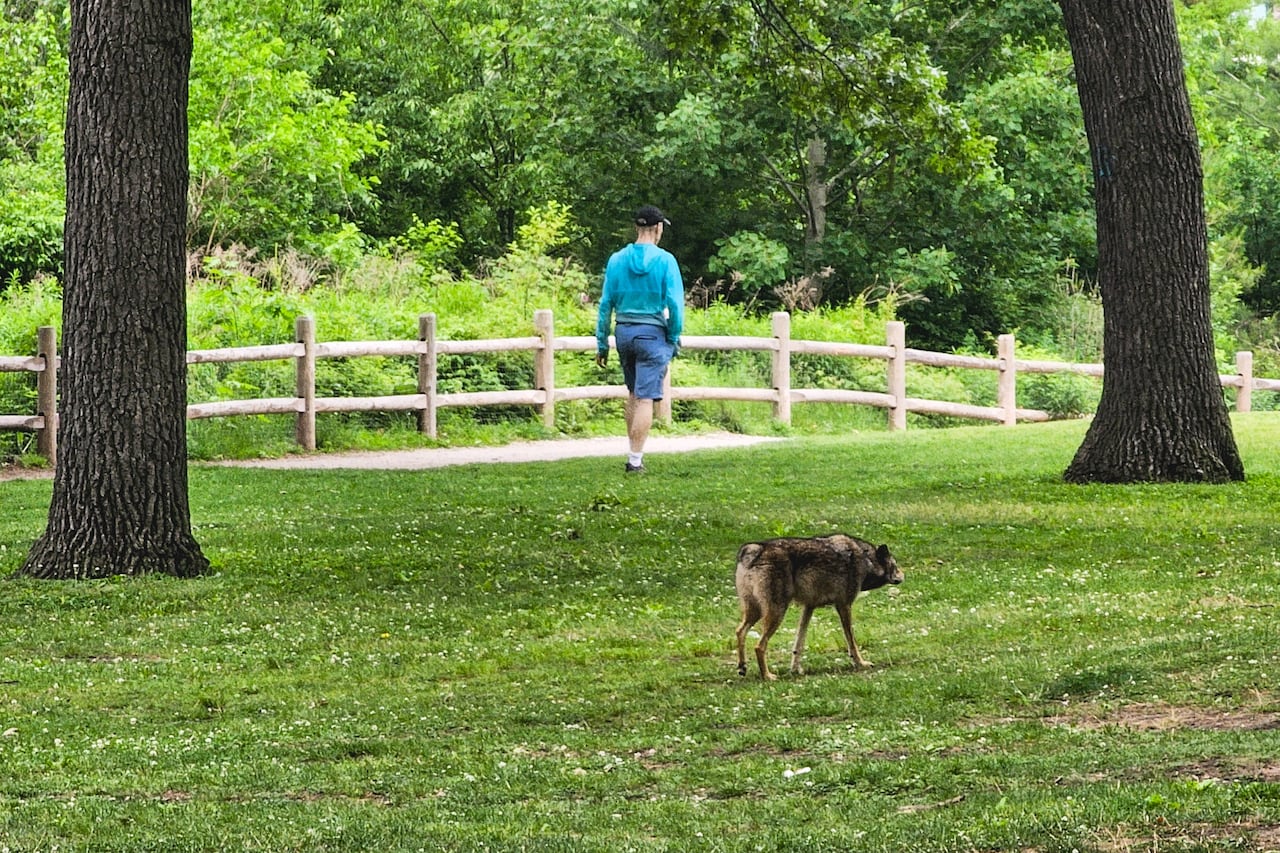
A coyote is spotted near a person in Toronto’s High Park on Wednesday, June 10, 2026. (Gio Ciampini/The Canadian Press)
In a discussion with CBC Toronto, Murray stated that the city’s strategy has not been effective, primarily due to the delay in deciding to euthanize problematic coyotes.
He remarked, “You can wave a garbage bag at them as much as you like, but that won’t change their behavior patterns.” He emphasized that there comes a time when more drastic measures are necessary to resolve such issues.
Murray suggested that municipalities leverage his research findings to craft more efficient coyote management strategies.
“The municipality can equip itself with improved information to make better-informed and more prompt decisions,” he stated.
Opposition to Culls
Murray clarified that he does not support widespread culling of coyotes, but advocates for identifying repeat offenders and euthanizing only those specific animals.
Dasoo communicated to CBC Toronto in her email that the emphasis on coexistence and hazing has proven effective.
She stated, “The City adopts a coexistence-based method for coyote management because evidence and experience suggest that long-term prevention, public education, minimizing attractants, and aversion conditioning are effective strategies for maintaining boundaries between wildlife and humans.”
“Coexistence initiatives are recognized as best practices in wildlife management and also support public health and environmental balance by allowing coyotes to fulfill their natural role in controlling populations of rodents and smaller animals.”

Camille Labchuk, executive director of Animal Justice, argues that euthanizing coyotes is unjust, as human encroachment has largely caused their interactions with people. (Mike Smee/CBC)
The animal rights organization Animal Justice questions the findings of the paper.
Executive director Camille Labchuk asserts that lethal measures are never justified, regardless of a coyote’s behavior in a community.
She expressed, “It seems unfair to kill coyotes for a problem created by humans, specifically their habitat destruction and loss, and this solution is not supported by the majority of people,” in an interview with CBC Toronto.
Labchuk proposed that relocation might be a viable solution for aggressive coyotes.
However, the city’s new policy indicates that while relocation may be feasible in other regions, it is generally considered a last resort and “is not a viable option within the Toronto context.”
Provincial regulations dictate that wild animals cannot be relocated beyond a kilometer from their capture site, and cities must seek provincial approval to transfer an animal to a sanctuary.
Murray argues that relocating coyotes to different jurisdictions often fails because they are inherently territorial and may return, while moving a troublesome coyote merely shifts the issue to another municipality.

Dog walker Elanja Corosky expresses that as an animal lover, she opposes the euthanization of any animals, including coyotes, but acknowledges that measures must be taken to protect both at-risk pets and the coyotes that have occasionally targeted them. (Mike Smee/CBC)
In Liberty Village, Murray’s findings received a mixed response from dog owners interviewed by CBC Toronto.
Many, like Elanja Corosky, expressed general opposition to euthanasia.
“As someone who loves animals, I do not want to see any animal euthanized,” she stated, including coyotes in her concerns. “However, if they are posing a significant threat, it is a situation that should be addressed.”

