
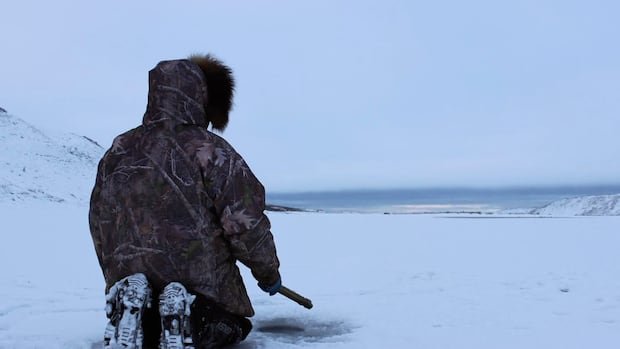
Lawrence Ruben efficiently drills through six inches of ice on the Hornaday River near Paulatuk, N.W.T. using an electric auger, taking only four seconds to complete the task. As water and ice particles emerge from the hole, he jokingly refers to the auger as “the best contraption since sliced bread” before proceeding to drill another hole. Ruben, along with his wife Dianne, have a cabin near the river where they often relax and fish for Arctic char.
During a recent fishing trip with their daughter and son-in-law, they had no luck catching Arctic char, which is unusual. Ruben, a member of the Paulatuk Hunters and Trappers Committee, mentioned that the char’s behavior has become unpredictable, deviating from their usual patterns of overwintering in the Hornaday and Brock rivers.
To investigate these changes, the community collaborated with Fisheries and Oceans Canada on a research project. They tagged 38 Arctic char with acoustic monitors to track their movements and behavior. These tags emit signals that are picked up by receivers placed in strategic locations, providing valuable data on the fish’s whereabouts.
The project aims to understand the migration patterns and habitat preferences of the char, especially in light of environmental changes in the Arctic region. With the Arctic undergoing rapid transformations, including diminishing sea ice thickness, the study seeks to shed light on how these changes impact the char’s life cycle and behavior.
The acoustic tags have a lifespan of four years, allowing researchers to gather long-term data on the fish. If a tagged fish is caught by harvesters, they have the option to release it back into the water or return the transmitter for a reward. By studying the char’s movements, researchers hope to gain insights into their migration triggers and habitat requirements.
Ruben reflected on how climate change has impacted the region, citing earlier ice melt and river erosion as significant indicators. The changes in the environment have affected the spawning grounds of the char, leading to concerns about the sustainability of this vital resource for the community.
As Ruben waits patiently by the fishing hole, hoping for a glimpse of the prized Arctic char, he emphasizes the importance of these fish as a crucial subsistence resource for the community of Paulatuk. The ongoing research project aims to safeguard the future of the char population amidst a rapidly changing Arctic landscape.

