
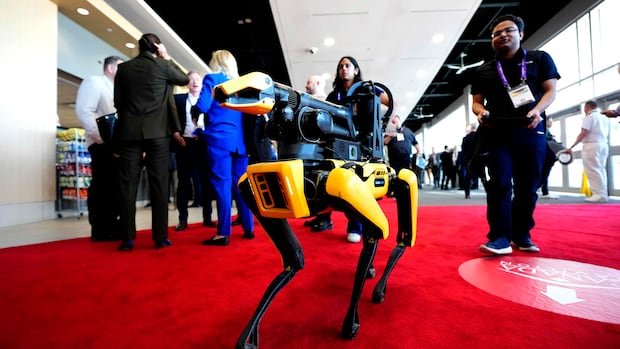
A global competition is currently in progress to integrate robotics into our daily routines, with a new wave of AI-driven robots offering enhanced versatility. The rapid progress in artificial intelligence has led to robots being utilized for various tasks, such as collaborating with humans in warehouses, delivering packages in urban areas, and inspecting hazardous sites.
Furthermore, robots are now capable of learning while on duty, and experts warn that Canada could miss out if it does not embrace adoption at this crucial juncture. The current buzzword in artificial intelligence is “physical AI,” a concept prominently showcased at the recent Consumer Electronics Show (CES).
The concept revolves around equipping physical systems like robots, autonomous vehicles, or industrial machinery with sensors so they can operate logically and responsively in the real world when combined with existing AI techniques. At CES, Google and Boston Dynamics announced a collaboration to test AI-powered robots in Hyundai auto plants, specifically two versions of a robot known as Atlas.
Although the development of general-purpose humanoid robots for household chores like dishwashing and laundry folding is still distant, the evolution of AI into the physical realm is evident. Traditionally, robots are programmed in a top-down manner to perform specific sequences of actions, suitable for controlled environments with repetitive tasks. However, a new approach inspired by generative AI allows robots to be trained in a bottom-up fashion, making them more adaptable and capable of learning autonomously.
This shift in methodology not only enables robots to adjust more rapidly but also empowers them to undertake more complex tasks requiring reasoning and decision-making capabilities. For instance, autonomous vehicles can be trained in virtual environments to navigate safely in dynamic settings. Companies like Waabi have developed realistic simulators to train self-driving vehicles effectively.
China is leading the way in driving robotics innovation and adoption globally, surpassing other countries in industrial robot installations. The nation’s focus on accelerating domestic manufacturing and exporting robotics technology is propelling its industry leadership. Conversely, Canada is trailing behind in robotics adoption, especially in industrial settings, which is impacting the country’s productivity growth.
Canadian companies face challenges in marketing robotics domestically, often needing to expand internationally for growth opportunities. Lack of familiarity with robotics, regulatory constraints, and the absence of a national robotics strategy are cited as factors hindering Canada’s adoption of robotics technology. Industry experts emphasize the need for Canada to formulate a comprehensive national robotics strategy to leverage the transformative potential of robotics technologies and remain competitive on the global stage.

