
Canada’s food regulatory authority has imposed a $10,000 penalty on a Loblaw-owned establishment for promoting foreign food items as Canadian. The Canadian Food Inspection Agency (CFIA) informed CBC News that a Toronto Superstore inaccurately utilized “maple leaf advertising decals” and a “Product of Canada” declaration in an in-store exhibit to boost a non-domestic product. The CFIA stated in an email that this misleading advertisement regarding the product’s origin led to the fine issued on Jan. 15, but the announcement was delayed until this week.
The CFIA has the authority to levy fines of up to $15,000 per violation. Both the federal agency and Loblaw declined to disclose the specific product that triggered the penalty. Situated on Gerry Fitzgerald Drive in the city’s northern region, the Superstore emphasized its efforts to maintain precise country-of-origin signage but acknowledged the challenges posed by handling extensive inventory. Canada’s largest grocer expressed regret for any confusion caused and emphasized ongoing enhancements to their operational processes.
The surge in the buy-Canadian movement, catalyzed by U.S. President Donald Trump’s tariff disputes and references to Canada potentially becoming the 51st state, was witnessed early last year. Capitalizing on this trend, grocers incorporated Canadian branding in their stores to promote locally sourced products, at times inaccurately. The CFIA’s decision to fine the Superstore follows a CBC News investigation last summer that uncovered prominent grocers promoting imported food items as having Canadian origins, a practice known as “maple washing.”
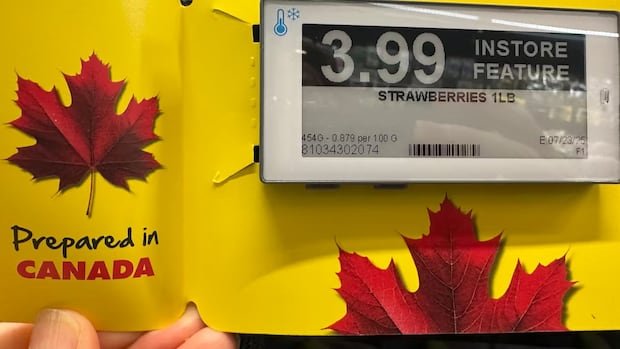
Federal regulations mandate that food labels and in-store signage must be accurate and devoid of any misleading information. Instances of inaccuracy revealed included a Toronto Sobeys advertising raw almonds with a red maple leaf symbol and a “Made in Canada” assertion despite Canada not cultivating almonds. Similarly, a Loblaw-owned Toronto No Frills was found displaying strawberries with signage featuring a red maple leaf and the phrase “Prepared in Canada,” contrary to the product’s actual origin from the USA.
Last September, some consumers expressed frustration at the CFIA’s failure to impose fines on grocers in numerous “maple washing” instances uncovered by the agency. The CFIA underscored its commitment to combating food mislabelling and emphasized that enforcement actions are determined based on various factors such as risk assessment, compliance history, and the company’s responsiveness to rectifying issues.
The agency is yet to address inquiries regarding why Sobeys evaded fines subsequent to a CFIA probe last April into a mislabelling incident resolved after four months. Sheila Young, who lodged a complaint with the CFIA over mislabelled avocado oil at a Sobeys-owned Safeway outlet near Edmonton, urged the agency to expedite the issuance of fines in such cases, citing the passage of ample time for grocers to rectify their practices.
According to the CFIA, the term “Product of Canada” denotes food that is entirely or predominantly produced within the country. For a food item to qualify as “Made in Canada,” its last significant transformation must occur domestically.

