
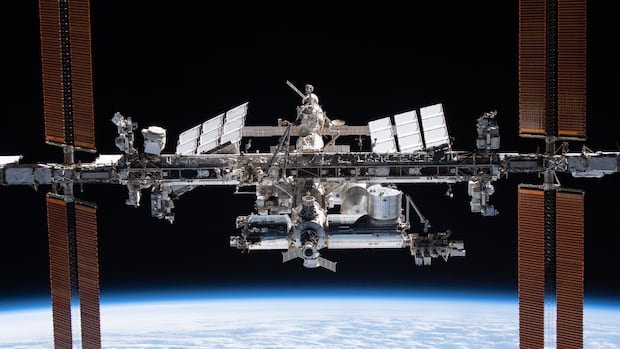
Historical structures, like the residence of Alexander Graham Bell in Nova Scotia, often transform into museums or national historic sites to safeguard their legacy for future generations. But how does one preserve a structure the size of a football field orbiting 400 kilometers above Earth?
NASA’s official strategy is to deorbit the International Space Station (ISS) at the end of its operational life, leading it into a controlled descent back into Earth’s atmosphere for a crash landing in a remote oceanic area. However, recent legislative proposals from some U.S. Government members urge NASA to reevaluate this plan and explore the possibility of storing the ISS in low Earth orbit instead.
Since its inception in 2000, the ISS has hosted numerous astronauts from the U.S., Russia, Canada, Europe, and Japan. Assembled through multiple space shuttle and Russian launches, this over 400-metric-ton scientific laboratory is the largest ever launched into space, facilitating a myriad of experiments unique to a microgravity environment.
With its useful life approaching its end, NASA disclosed in January 2022 that the space station will be decommissioned by 2030 and deorbited in 2031. The current plan involves a SpaceX rocket propelling the ISS on a crashing trajectory through the atmosphere, resulting in its disintegration over a remote Pacific region, akin to the fate of its predecessor, the Russian Space Station MIR.
However, some advocates, including former NASA chief of staff U.S. Rep. George Whitesides, are pushing for a reevaluation. Whitesides emphasized the need to explore alternatives before permanently disposing of the ISS, considering its significance as a monumental engineering feat in human history.
Maintaining the ISS in orbit poses challenges. The station must be regularly boosted to counter atmospheric drag, preventing an uncontrolled descent akin to the fate of Skylab, the first U.S. space station. Despite proposals to elevate the ISS to a higher orbit, concerns about fuel requirements, structural integrity, and collision risks with space debris remain.
NASA’s call for private entities to take over the ISS yielded no viable proposals, signaling the challenges of maintaining the aging complex. While NASA shifts focus towards lunar and Mars missions, the possibility of orbiting space stations persists, with China’s Tiangong already operational and private enterprises planning their space initiatives.
Although Rep. Whitesides’ proposal is still undergoing legislative processes, the likelihood remains that the ISS, after three decades of service and a $100 billion investment, will meet its end through controlled incineration in the atmosphere and oceanic burial, unless innovative solutions emerge.

