
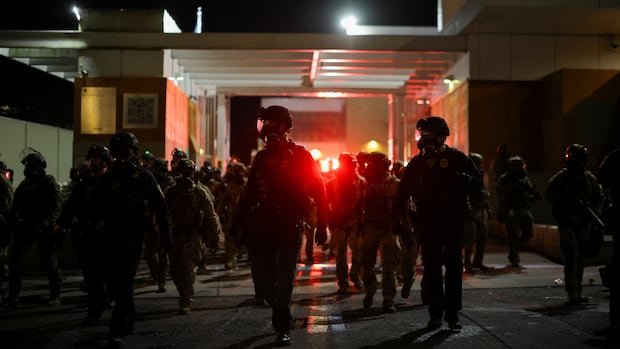
In a recent ruling, a divided U.S. appeals court has allowed President Donald Trump to deploy National Guard troops to Portland, Oregon, overruling objections from city and state leaders. The court decision granted the Justice Department’s request to halt a previous order blocking the deployment, citing the need to address protesters who had caused damage to federal buildings and posed threats to law enforcement officers.
The majority opinion, supported by Circuit Judges Bridget Bade and Ryan Nelson appointed by Trump, deemed the National Guard deployment as a suitable response to the situation. However, Circuit Judge Susan Graber, appointed by Democratic President Bill Clinton, dissented, expressing concerns about the broad authority granted to the president in such matters.
Oregon Attorney General Dan Rayfield and critics voiced apprehensions about the ruling, warning of potential dangers associated with granting the president unilateral power to deploy troops in the state without sufficient justification.
The White House welcomed the court decision, emphasizing Trump’s lawful authority to safeguard federal assets and personnel from ongoing protests. Trump has sought U.S. Supreme Court intervention to determine the extent of his authority to send troops to Democratic-led cities, following a previous appeals court ruling against his actions in Chicago.
Separately, U.S. District Judge Karin Immergut, appointed by Trump, had earlier questioned the legality of Trump’s deployment of National Guard troops to Portland, issuing a temporary block on further deployments pending a trial to assess the situation. Trump’s decision to deploy troops to various cities, including Los Angeles and Washington, D.C., has sparked legal challenges from Democratic-led states and local officials, leading to ongoing debates over the appropriate use of military forces for domestic purposes.
The legal battles reflect a broader disagreement over the interpretation of laws governing the use of military forces within the country, particularly in response to civil unrest and protests. While Trump’s administration asserts the need to maintain law and order, critics argue that such deployments could infringe on states’ rights and constitutional protections.
As the legal disputes continue, the role of the National Guard in domestic law enforcement remains a contentious issue, with conflicting rulings from different appeals courts adding complexity to the ongoing debate on presidential powers in deploying military personnel within U.S. cities.

