
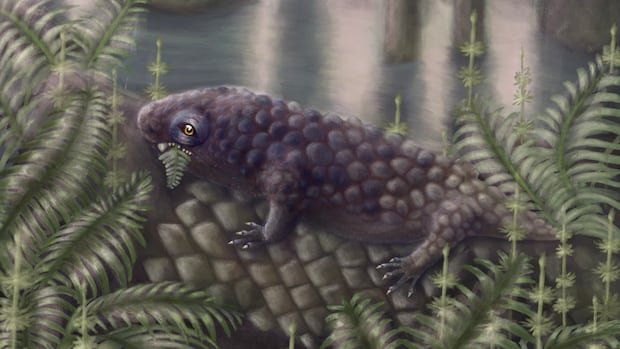
A recently unearthed creature, about the size of a football, with the ability to grind its teeth like a dedicated plant-eater, potentially stands as one of the earliest known herbivorous vertebrates. Dubbed Tyrannoroter heberti, this species roamed the Earth some 307 million years ago during the late Carboniferous Period in a lush fern-covered swamp on what is now Cape Breton Island in Nova Scotia. This finding challenges the prevailing belief that early tetrapods primarily consumed other animals due to their inability to process plant matter.
According to a recent study, Tyrannoroter heberti is the oldest known tetrapod with dental adaptations suited for a plant-based diet. Arjan Mann, the lead author of the study published in Nature Ecology and Evolution, highlights how this discovery reshapes our understanding of the pace at which this dietary transition occurred.
Belonging to the microsaur group, Tyrannoroter was a small, lizard-like creature that coexisted with reptiles and mammals before their emergence. Fossil remains of this species, including a significant portion of its skull, were found entwined with other animal fossils within the roots of a massive petrified tree stump on Cape Breton Island. The stump, discovered by amateur paleontologist Brian Hebert, measures around three to four meters across, a remarkable find that led to the species being named heberti in his honor.
Mann, working alongside Hebert during his doctoral research, suggests that Tyrannoroter’s skull bears resemblance to the pantylids, a group of microsaurs known for their short, robust bodies and digging adaptations. Despite the typically diminutive size of pantylids, Tyrannoroter stood out for its larger size, approximately that of a football, earning it the moniker “tyrant digger.”
A distinctive feature of Tyrannoroter was its multiple rows of teeth shaped like Hershey kisses, uniquely suited for consuming shoots, leaves, and fibrous plant material. These teeth, although reminiscent of insect-eating animals, possessed additional rows or “batteries” that provided the necessary surface area for grinding plant matter.
The presence of similar teeth in older relatives of Tyrannoroter, dating back as far as 318 million years, hints at an early adaptation to a plant-based diet within this animal group. This dietary shift among tetrapods became crucial as they transitioned from water to land around 375 million years ago, with plants flourishing but lacking suitable digestive mechanisms for tetrapods. Mann speculates that early herbivores like Tyrannoroter may have acquired cellulose-digesting capabilities by consuming insects, leading to the evolution of herbivorous traits.
The study’s findings have garnered praise from paleontologists like Robert Reisz, who views the hypothesis of Tyrannoroter being an herbivore as an intriguing avenue for further investigation. While acknowledging the challenges of inferring body shape solely from skull remains, Reisz emphasizes the significance of studying teeth wear patterns to decipher dietary habits accurately.
The discovery of Tyrannoroter sheds light on the early evolution of herbivorous tetrapods and their impact on ecosystems, highlighting the importance of understanding these ancient dietary adaptations in the broader context of evolutionary history.

