
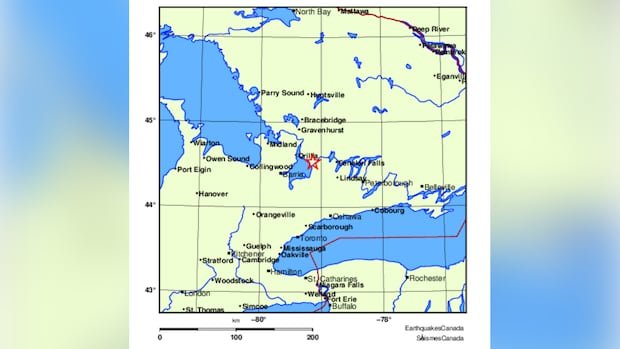
Thousands of residents in southern and central Ontario felt the effects of an earthquake late on Tuesday night, as confirmed by Natural Resources Canada. The seismic event, with a magnitude of 3.7, was registered by Earthquakes Canada approximately 99 kilometers northeast of Toronto shortly before 11 p.m. ET. The epicenter of the tremor was pinpointed 23 kilometers southeast of Orillia, Ontario, at a depth of five kilometers.
According to Marikah Adams, a seismologist with Natural Resources Canada, around 2,600 individuals have reported sensing the earthquake, with reports extending from Kingston to Kitchener. More reports are expected to come in as the situation unfolds. One resident, Sarah Cowley, described hearing a “roaring sound” as her home experienced shaking during the quake. Despite the intense moment, there appeared to be no visible damage when she checked outside her window.
The earthquake was felt across a wide area, with over 2,000 reports submitted through the “Did you feel it?” link, reaching as far west as Kitchener, east to Belleville, and south to Niagara Falls. While there have been no immediate reports of damage or injuries, historical data from Earthquakes Canada indicates that the region has previously encountered earthquakes of similar size, with the largest being a magnitude 5.5 quake in 1929.
The seismic activity in this intraplate region within the North American plate is considered uncommon, as explained by Adams. The cause of the earthquake is not definitively known, but it could be attributed to regional stress fields or reactivated faults within areas of crustal weakness. Lindsay Schoenbohm, a geologist from the University of Toronto, mentioned that pressure accumulation near old faults or buried cracks in the tectonic plate can lead to these types of seismic events, often referred to as “snap, crack, pop earthquakes.”
Adams emphasized that while earthquakes may be infrequent in this area, the event serves as a reminder of their unpredictability. She advised individuals to follow safety protocols during earthquakes, such as “stop, drop, cover, and hold on.” Additionally, Schoenbohm noted that seeking shelter under a heavy table or bed is safer than standing in a doorway during an earthquake, as previously believed.
Social media reactions highlighted the recent challenges faced by the region, including extreme weather conditions. For Cowley, the earthquake serves as a reminder of the power of nature and the importance of preparedness.
In comparison to Earthquakes Canada’s data, the U.S. Geological Survey (USGS) recorded the earthquake as a magnitude 4.1, occurring at a depth of 11.5 kilometers. The discrepancy in reports between the two agencies may be attributed to different monitoring stations or measurement scales used. According to Stephen Crane from Natural Resources Canada, Earthquakes Canada is the authoritative source for earthquake information within the country.
In conclusion, while the earthquake in Ontario has stirred attention and curiosity, it underscores the necessity of being vigilant and prepared for such natural occurrences. It also highlights the significance of reliable sources for obtaining accurate information during seismic events.

