
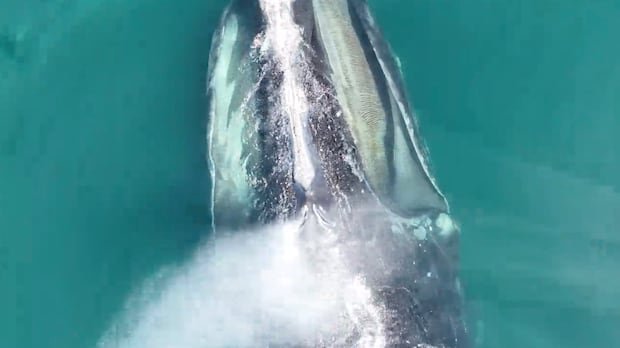
A recent study conducted by researchers at the Woods Hole Oceanographic Institution in Massachusetts has discovered that analyzing microbes found in the breath of North Atlantic right whales can provide valuable insights into the health of these endangered animals. Using drones equipped with petri dishes to capture respiratory spray from the blowholes of the whales, the scientists were able to examine the bacteria present in the spray and correlate this data with other health indicators to better understand the well-being of individual whales.
The study, led by Carolyn Miller, a research associate at WHOI, was published in the journal International Society for Microbial Ecology. With fewer than 400 North Atlantic right whales remaining in the world, the species faces threats such as ship strikes and entanglements in fishing gear.
Since 2016, the researchers have collected 103 samples from 85 North Atlantic right whales in Cape Cod Bay, Massachusetts, using the drone technique. This method involves flying a drone with a petri dish above a whale to capture its exhaled breath, which is then analyzed to assess the whale’s health status.
By analyzing the microbial samples collected from the whales’ breath along with detailed images and health data, the researchers found a correlation between the types of bacteria present in the breath and the health condition of the whales. Thin whales tended to have bacteria associated with infections, while robust whales had bacteria linked to nutrient-rich environments.
According to Miller, collecting breath samples using drones is a safer and less invasive approach compared to previous methods that required close proximity to the animals. The drones go unnoticed by the whales, making the process stress-free for the animals and researchers.
Sean Brillant, a senior conservation biologist with the Canadian Wildlife Federation, praised the study as a novel and valuable approach to understanding and monitoring the health of North Atlantic right whales. The research could help in assessing the long-term health effects of entanglements and ship strikes on these whales, providing crucial insights for conservation efforts.

