
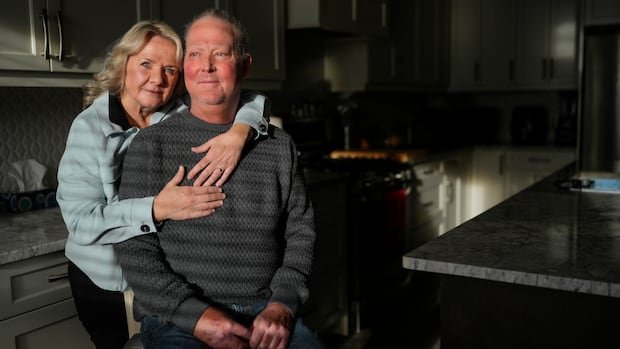
Steve Blake felt fortunate when he moved into his newly built home in 1995. The house was sturdy, well-constructed, and free of any leaks. His basement was a comfortable workspace where he spent about six hours a day, five days a week, after sending his children off to school. Little did he know that his long hours in the basement could be posing a serious health risk.
In 2023, at the age of 55, Steve started experiencing a persistent cough. Initially unconcerned due to his active lifestyle and good health, his outlook changed drastically when he struggled to breathe one morning before a golf game. Subsequent medical tests revealed the devastating diagnosis of inoperable Stage 4 lung cancer, giving him only a year to live.
Steve, a non-smoker with no exposure to secondhand smoke, and his wife Kelly were bewildered by the diagnosis. Through research, they discovered the potential culprit: radon gas. This invisible, odorless gas can accumulate in homes, leading to hazardous health consequences. When Steve finally tested his basement for radon levels, the results consistently showed high readings during the winter months.
Despite the lack of conclusive evidence linking his cancer to radon exposure, Steve remains haunted by the possibility that his basement environment contributed to his illness. The concerning reality of radon exposure in homes has prompted a group of scientists across Canada to embark on innovative research aimed at detecting radon exposure through toenail clippings.
The team’s objective is to collect 10,000 toenail samples from various regions in Canada, along with monitoring participants’ home radon levels. This groundbreaking study, funded by the Canadian Cancer Society and scheduled for completion by 2028, intends to build on prior findings indicating measurable lead levels in nail clippings spanning over a decade.
The researchers’ ultimate goal is to develop a noninvasive or minimally invasive test using toenail samples to assess individuals’ long-term radon exposure. This advancement could potentially influence lung cancer screening criteria, which currently focus primarily on smokers. The urgency of such research is underscored by the increasing instances of lung cancer among non-smokers in Canada.
While efforts to raise awareness and mitigate radon exposure in homes are critical preventive measures, the prevalence of radon-related health risks remains a widespread concern in Canadian households. The evolving research landscape and collaborative initiatives aim to address gaps in public understanding and healthcare strategies to combat the insidious threat of radon-induced lung cancer.

