
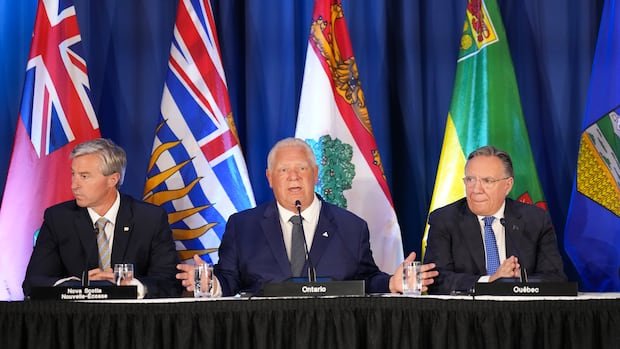
Five provincial leaders are urging the federal government to retract its recent proposal for restrictions on the notwithstanding clause, claiming it negates the essence of the agreement that led to the creation of the Charter of Rights and Freedoms. The notwithstanding clause, found in the Constitution, allows provincial legislatures or Parliament to pass laws that supersede certain provisions of the Charter for a limited period of five years.
In a recent submission to the Supreme Court of Canada regarding Quebec’s secularism law, the federal government argued that the constitutional restrictions on the notwithstanding clause prevent its misuse to distort or eliminate the rights guaranteed by the Charter. It emphasized that the temporary nature of the clause prohibits any permanent impairment of Charter rights.
The premiers of Ontario, Quebec, Alberta, Saskatchewan, and Nova Scotia penned a letter to Prime Minister Mark Carney, urging the federal government to reconsider its stance and withdraw its legal arguments. They expressed concerns that the federal government’s position puts novel constraints on the authority of elected legislatures to utilize the notwithstanding clause.
The premiers highlighted that the federal government’s arguments undermine national unity by challenging the sovereignty of provincial legislatures and infringing on the foundational principles of federalism and democracy. They warned that such actions could have significant implications for Canadian federalism.
The case in question involves the attorney general of Quebec as the respondent, with several attorneys general from other provinces participating as interveners. Justice Minister Sean Fraser emphasized the broader implications of the case, noting that the Supreme Court’s ruling will shape the future use of the notwithstanding clause by both federal and provincial governments.
Ontario emphasized the importance of the notwithstanding clause in preserving Canada’s constitutional democracy, allowing elected representatives to enact laws deemed crucial to the public interest despite certain Charter provisions. Ontario argued that the notwithstanding clause should not be viewed as a flaw to be corrected through judicial reinterpretation.
Ontario Premier Doug Ford criticized the federal government’s stance, particularly targeting Justice Minister Sean Fraser and Prime Minister Mark Carney. Ford condemned the federal position, labeling it as disastrous and challenging the supremacy of legislatures over judicial interference in matters that he believes should not be within the courts’ purview.

