
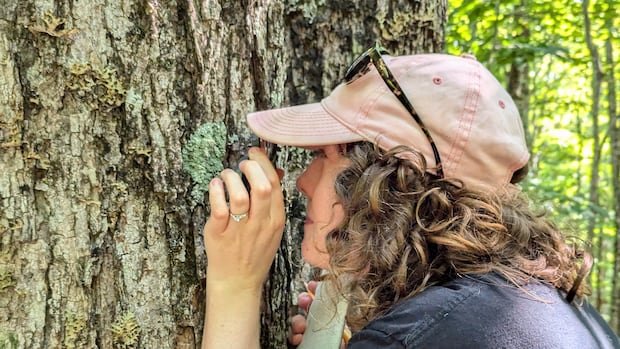
A team of researchers from the Nature Trust of New Brunswick is actively seeking four distinct types of lichens, and recently discovered one in a rather unique location. The scaly fringe lichen, scientifically identified as heterodermia squamulosa, was detected between Alma and Riverside-Albert, situated east of Fundy National Park. According to Ilana Urquhart, a conservation coordinator at the Nature Trust, this finding represents the species’ furthest eastern recorded occurrence.
Lichens, which are a symbiotic relationship between a fungus and photosynthetic partner like algae, typically manifest as grey, yellow, or green crusty patches growing on surfaces such as trees, resembling moss. Although lichens can be challenging to locate, they are commonly found on rocks and trees. Despite previous discoveries west of Fundy along the coast and sporadically on Grand Manan, locating lichens, including the scaly fringe, the wrinkled shingle, the blue felt, and the white-rimmed shingle varieties, remains a demanding task.
The conservation status of these lichen species in New Brunswick has been assessed, highlighting their scarcity levels. The wrinkled shingle lichen is deemed endangered, while the white-rimmed and scaly fringe lichens are classified as threatened, and the blue felt lichen is a species of special concern. Urquhart emphasized that lichens serve as valuable indicators of a healthy environment capable of sustaining diverse species.
Habitat loss, primarily due to activities like logging and harvesting, poses the most significant threat to lichens, as per Urquhart. Given the limited observational data available on these lichens, the Nature Trust’s discoveries will be shared with fellow researchers and contribute to the province’s dataset. The Nature Trust secured funding from Environment Climate Change Canada through the Habitat Stewardship Program to support projects focusing on the conservation of at-risk species.
Since 2022, the researchers at Nature Trust have been actively searching for lichens, expanding their search efforts this year. They have successfully located the scaly fringe lichen, white-rimmed shingle lichen, and the wrinkled shingle lichen. Targeting regions like Charlotte County, the Wolastoq (St. John River), and the coastal islands of the Bay of Fundy, the team is still on the lookout for the blue felt lichen, known to be present in Charlotte County and Grand Manan.

