
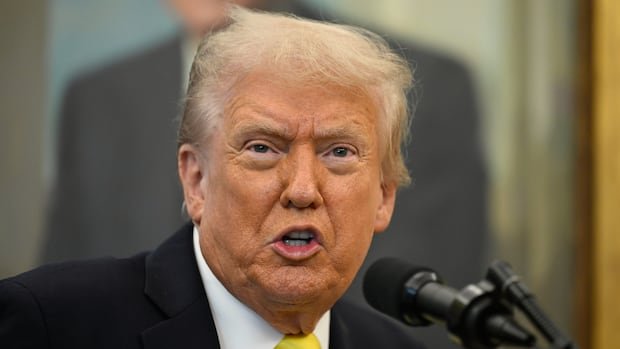
The Supreme Court is set to review President Donald Trump’s utilization of the 1977 International Emergency Economic Powers Act (IEEPA) to enforce extensive global tariffs. If the Court rules against Trump’s use of this statute, it would remove a key tool he has wielded to levy tariffs on countries that have incurred his displeasure on non-trade-related political issues. The case, initiated by small business associations and multiple states, is under consideration by the Court’s conservative majority, including three justices nominated by Trump during his initial term. The timeline for the Court’s decision remains uncertain.
Trump is the first president to leverage the IEEPA, typically employed for imposing punitive economic sanctions on adversaries, to institute tariffs. The statute grants the president authority to address “an unusual and extraordinary threat” to U.S. national security, foreign policy, or economy. Trump declared a $1.2 trillion U.S. goods trade deficit in 2024 as a national emergency, despite the U.S. consistently running trade deficits since 1975.
If the Supreme Court invalidates the IEEPA-based tariffs, U.S. Treasury Secretary Scott Bessent anticipates a shift to alternative tariff mechanisms, such as Section 122 of the Trade Act of 1974, enabling 15% tariffs for 150 days to alleviate trade imbalances. Additionally, Trump could invoke Section 338 of the Tariff Act of 1930, permitting tariffs up to 50% on nations discriminating against U.S. commerce. Trump has already employed diverse authorities for specific tariffs, including Section 232 of the Trade Expansion Act of 1962 concerning national security interests in sectors like autos, copper, and pharmaceuticals.
Opponents of Trump’s tariffs argue that the major questions doctrine, necessitating clear congressional authorization for significant executive branch actions, should invalidate the tariffs. The critics contend that Congress, not the president, holds the constitutional authority to levy taxes and tariffs. Despite legal challenges, Trump has continued to implement tariffs as part of his trade strategy, aiming to negotiate favorable trade terms with various countries. The outcome of the Supreme Court’s ruling on the IEEPA tariffs could have significant implications for the U.S. economy and trade relations.

