
On Thursday, Ontario Premier Doug Ford unveiled the province’s new framework for data centres, asserting that it will “ensure Canadians’ data stays in Canada.”
The framework for approving data centres is constructed around three main principles: economic development, data protection and sovereignty, and community investment and public trust.
“With our new data centre playbook, our government is committed to developing the economy of the future, which will generate billions in growth, boost tax revenues, and create thousands of new jobs, all while ensuring data centres comply with established rate rules,” Ford stated during the announcement in Guelph.
“Our framework mandates that data centres bear the complete cost of their electricity consumption, promoting initiatives to develop their own power sources and creating a separate rate class for large new data centres that will be higher than the current industrial rate programs for major electricity consumers. No expenses will be transferred to hardworking families in Ontario.”
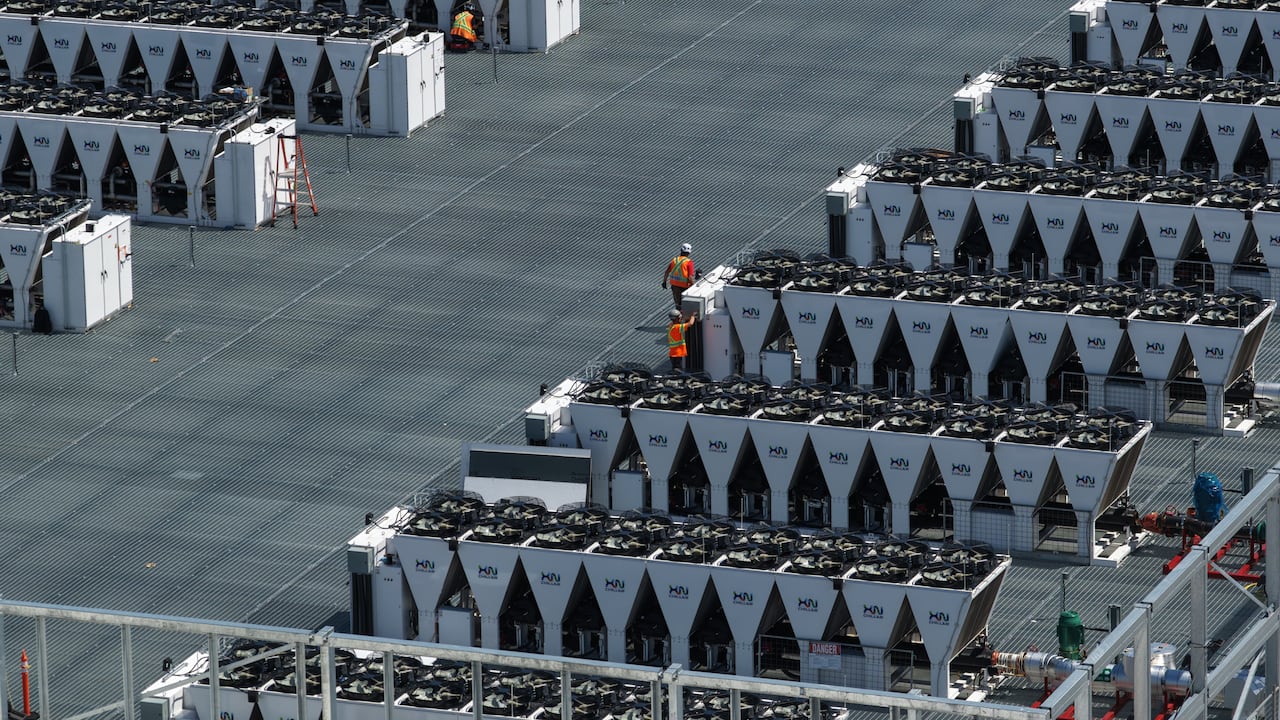
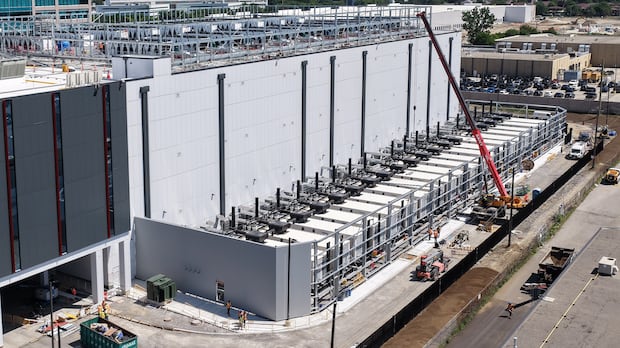
An aerial photograph of the construction of the TOR1X0 Data Centre at SteelesTech Campus in Toronto. The Ontario government has introduced a new “playbook” that data centres must follow. (Patrick Morrell/CBC)
Ford further indicated that the province “will not be providing financial incentives to draw in investments.”
According to the province, its framework will act as a “key enabler” of its artificial intelligence (AI) strategy, which is projected to yield economic advantages including $122 billion in growth by 2035 and the addition of 17,000 new jobs each year.
This announcement arrives as various municipalities throughout the province are considering moratoriums on data centres, with Oakville having voted for a one-year moratorium on Tuesday, while Mississauga is set to decide on its own moratorium in September.
-
Residents argue Toronto’s request for a provincial data centre framework is insufficient; a moratorium is necessary
-
CEO behind Hamilton proposal argues cleaner AI data centres are preferable to inaction
Ontario Greens claim playbook is ‘inadequate’
Last week, Mike Schreiner, leader of the Green Party of Ontario, called for a halt on data centre projects. He expressed concern that corporations benefit from local water resources rather than Ontario communities.
Ilham Abdulkadir, a member of Wellington Water Watchers, joined Schreiner in his plea, emphasizing that the infrastructure for data centres is “primarily physical,” requiring land, energy, and a “huge demand for water.”
In Toronto, over 5,000 residents have signed petitions raising concerns regarding data centres in their neighborhoods.
Vic Fedeli, Ontario’s Minister of Economic Development, stated that the province will “ensure priority for data centres utilizing a closed-loop system.”
A closed-loop system operates similarly to a car radiator, recycling water to minimize consumption.
Ford echoed this sentiment, asserting that his administration will be “favoring constructions that employ closed-loop systems which use virtually no water during their operations.”
“I believe there is much to learn about data centres,” the premier remarked. “It’s ironic for a municipality to say, ‘I don’t want a data centre,’ while all local businesses depend on one. They require AI, my hospital relies on AI, and everyone in that community utilizes social media and computers. It simply doesn’t make sense.”

Green Party of Ontario Leader Mike Schreiner is urging the province to halt approvals for new AI data centres. (Evan Mitsui/CBC)
However, Schreiner believes the playbook “fails to meet expectations.”
“The premier employed a lot of vague and reassuring terminology. They provided no concrete details, specifics, or robust regulations, such as prohibiting the establishment of a data centre in Ontario without a closed-loop water system,” Schreiner conveyed to CBC News.
“Thus, until such protections are implemented… the Ontario Greens are advocating against any new data centres.”
Schreiner acknowledged the significance of data protection and sovereignty, recognizing that data centres will “play a role in our future.”
“Nevertheless, we want to ensure that communities and individuals maintain control, rather than tech billionaires and fossil fuel corporations,” he stated.
“[The Ontario Greens will] persist in calling for a moratorium until robust regulations are established to safeguard people and communities from data centres.”
-
Video
New $40M federal investment to bolster tech businesses in the Waterloo region
-
Video
‘Hundreds and hundreds of jobs’: Minister announces $40M investment into Waterloo region and Brant businesses
Waterloo region assessing local implications
Earlier this week, Councillor Colleen James submitted a motion requesting staff to create an information report for the Region of Waterloo council, aimed at informing elected officials about the development of data centres and their economic and environmental consequences.
James remarked that the growth of data centres is “inevitable” and that there is much to be learned.
Wilmot Mayor Natasha Salonen has expressed concerns regarding the staffing resources needed to compile such a comprehensive report, but CAO Darshpreet Bhatti indicated that staff are already “developing a plan that will address many of the requests being made.”
“This isn’t about finances; it’s about community. Community safeguards, frameworks, and what is currently in place,” James emphasized.
The report is anticipated to be finalized early next year.

