
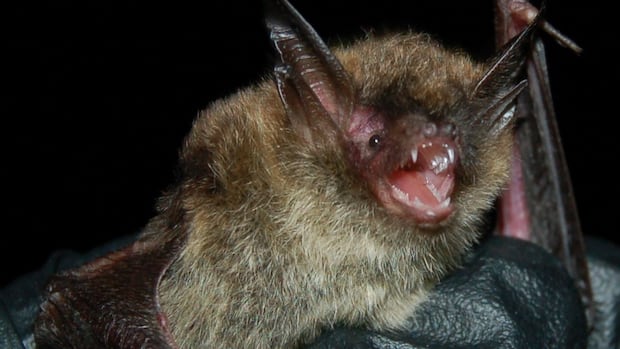
While many people tend to steer clear of bats, a local environmental organization in Sudbury aims to transform that apprehension into curiosity by examining the city’s bat population.
The Junction Creek Stewardship Committee organized a “bat walk” at Park Lawn Cemetery over the weekend, inviting community members to participate in the search for these nocturnal creatures.
Given that bats are primarily active at night and can be challenging to spot, attendees utilized iPads equipped with echometers to detect the high-frequency sounds that bats produce through echolocation.
“There’s considerable interest in bats within the Sudbury region,” remarked Evan Voutier, an ecological technician affiliated with the committee.
“We have discovered that there is a lack of research concerning bats in our locality. Therefore, we’re attempting to contribute to that knowledge while also engaging the public in our research and demonstrating our methods.”

Evan Voutier, an ecological technician with the Junction Creek Stewardship Committee, holds an echometer linked to an iPad. (Faith Greco/CBC)
The Junction Creek Stewardship is investigating how bats utilize various habitats across Greater Sudbury.
“We are not solely concentrating on optimal habitats or those that support large bat populations; we are also examining areas where habitat disturbances occur and analyzing the effects and types of bats found in those locations in comparison to others,” Voutier explained.
Abandoned mines, which are plentiful in northern Ontario, serve as crucial hibernation spots for some bat species during the winter months.
Declining Bat Populations
Franco Mariotti, a biologist and naturalist who volunteers for the organization, emphasized the importance of increasing knowledge about local bats as they continue to face various threats.
“Bats are classified as endangered due to the white-nose fungus that is decimating their numbers.”
White-nose syndrome, a fungal infection that impacts hibernating bats, has led to significant decreases in bat populations throughout North America. It causes bats to awaken too frequently during hibernation, leading to the depletion of their stored energy and starvation before spring arrives.
Certain bat species also encounter dangers from wind turbines. The rapid shifts in air pressure around rotating turbine blades can create gas bubbles in bodily fluids, akin to decompression sickness, commonly known as “the bends.” Mariotti noted that this can result in severe internal injuries and often death.
Despite the dwindling numbers, he mentioned that the research conducted by the group has confirmed the presence of bats throughout the Sudbury area.

Franco Mariotti, a biologist and naturalist, is a volunteer and founding member of the Junction Creek Stewardship Committee. (Faith Greco/CBC)
“Of the eight bat species found in Ontario, how many are present in Junction Creek? All eight,” he stated.
“This is what we have learned over the past year, which is quite remarkable. All of Ontario’s bat species can be found right here in downtown Sudbury.”
He emphasized that bats are vital as they are primary predators of insects, aiding in the management of agricultural and forest pests.
Mariotti expressed his hope that the public “bat walks” will alter perceptions about these creatures.
“Bats are one of those unique animals that truly captivate and inspire wonder about the natural world,” he remarked.
The Junction Creek Stewardship Committee is set to hold another public “bat walk” on August 19.

