
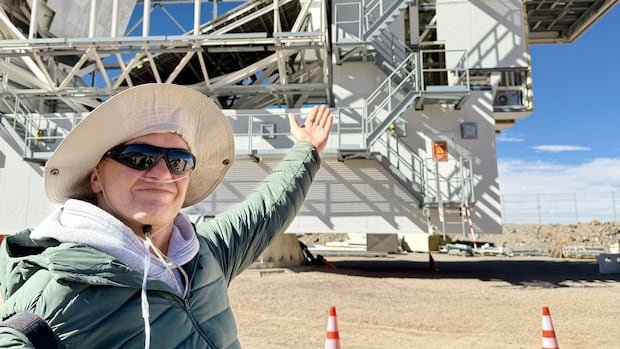
A groundbreaking new telescope, spearheaded by Canadian researchers, is positioned atop a peak in Chile’s Atacama Desert, standing at an elevation higher than the Mount Everest base camp. The Fred Young Submillimeter Telescope, located at 5,600 meters above sea level, offers an unparalleled view of the universe due to its lofty height and arid environment, ensuring minimal interference from atmospheric elements.
Mike Fich, the lead astronomer from the University of Waterloo, emphasized the telescope’s remarkable clarity, comparable to space telescopes but at a fraction of the cost. The project aims to shed light on the formation and movement of stars and galaxies, dark energy, dark matter, and the origins of the universe, providing insights into the distant past by observing galaxies billions of years old.
Collaborating with institutions from Chile, Germany, and Canada, the project is spearheaded by Cornell University’s CCAT Observatory. Canadian researchers from various universities, including the University of Toronto, the University of Alberta, McGill University, and McMaster University, are actively involved in the initiative. The telescope’s advanced technology allows for broad-spectrum observations, enabling swift scanning of vast expanses of the sky.
Led by Scott Chapman of Dalhousie University, the Canadian team has developed cutting-edge quantum sensor cameras capable of detecting submillimeter wavelengths of light, vital for observing cold gas clouds where stars form. This pioneering technology, in development for over three decades, surpasses the capabilities of traditional telescopes like the Hubble Space Telescope.
The project’s total cost, approximately $40 million USD, excludes additional components such as cameras. The telescope’s construction posed challenges, requiring rigorous fitness tests and oxygen supply due to the extreme altitude. The system’s components, weighing up to 55 tonnes, were assembled in Chile after being built in Germany. A dedicated power station was erected at a lower altitude to provide energy, overcoming the limitations of burning diesel at high altitudes.
Chapman’s quantum sensor cameras are scheduled for installation this summer, with initial data expected by mid-fall. The extensive data collected will undergo thorough analysis before being publicly released, offering exciting prospects for groundbreaking discoveries in the realm of astrophysics.

