
The presence of U.S. military troops near Venezuela and a series of lethal assaults on suspected drug-carrying vessels in the waters adjacent to its shores have prompted concerns about a potential coup or invasion targeting the South American nation.
The Trump administration has openly expressed its desire to see Venezuelan President Nicolás Maduro removed from power. President Trump has labeled Maduro as a drug kingpin, accused Venezuela of releasing criminals into the U.S., and alleged drug exports to the country.
Speculation arose following Trump’s contemplation of land operations within Venezuela, suggesting a potential coup or military intervention to depose the leader. However, experts suggest that such actions by the U.S. government would encounter significant opposition.
William LeoGrande, a government professor at American University specializing in Latin America, remarked that a full-scale U.S. military incursion to defeat the Venezuelan armed forces and occupy the country seems improbable.
Despite historical U.S. involvement in Latin American affairs, LeoGrande highlighted that the U.S. has never invaded a nation south of Panama, with interventions primarily in Central America and the Caribbean.
Recent operations by U.S. forces have destroyed nine boats and resulted in 37 fatalities. Defense Secretary Pete Hegseth disclosed two strikes on suspected drug-carrying vessels in the eastern Pacific Ocean.
The U.S. accuses these vessels of engaging in drug trafficking without presenting evidence and treats the alleged traffickers as unlawful combatants, drawing criticism for potential violations of domestic and international laws.
Additionally, Trump revealed authorizing CIA covert actions in Venezuela and announced a $50 million USD reward for information leading to Maduro’s arrest on drug charges. The U.S. has bolstered its military presence in the region, including warships, fighter jets, and personnel.
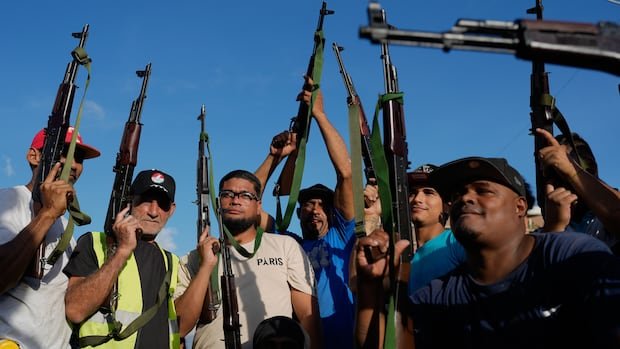
While the possibility of a U.S. invasion remains uncertain, potential challenges include Venezuela’s substantial weapons stockpile, the involvement of various armed groups, and the Bolivarian militia recruited by Maduro to deter foreign intervention.
The risks associated with regime change in Venezuela, despite past U.S. interventions in Latin America, pose complex obstacles. Overthrowing Maduro may not be a straightforward task, as maintaining military loyalty remains crucial.
Ramsey emphasized Maduro’s adeptness at ensuring military support through years of “coup-proofing,” making a sudden switch in allegiance improbable. The current U.S. approach, focused on anti-drug measures, may continue with targeted strikes rather than direct intervention.
Internal divisions within the Trump administration, involving differing approaches to Venezuela, suggest uncertainty in the course of action. The influence of advocates for regime change like Marco Rubio contrasts with proponents of diplomacy, indicating a nuanced decision-making process.
At present, the more interventionist stance appears dominant, but potential ramifications akin to the Libyan scenario could prompt a reevaluation. Trump’s decision-making on Venezuela hinges on balancing conflicting viewpoints within his administration.

