
The latest additions to the Oxford English Dictionary (OED) include seven new terms from Canadian English, reflecting the diverse linguistic landscape of the country.
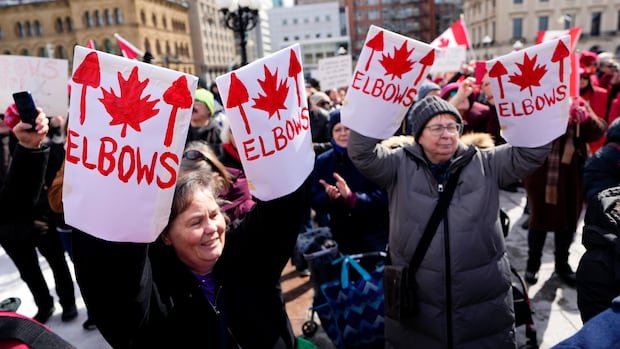
One of the newly added entries is “cashspiel,” referring to a competition for cash prizes, often associated with curling tournaments. Another term is “elbows up,” used to signify readiness to defend oneself or fight back. Additionally, “grunt” describes a dessert made of stewed fruit with a biscuit topping cooked on a stovetop. “Kitty-corner” denotes a diagonal position, while “kokum” is a Cree term for grandmother or elderly woman.
“Land acknowledgment” is recognized as a formal statement honoring Indigenous land occupants. “Point form” refers to presenting information in a concise list format.
The OED tracks new word emergence through various methods, including crowdsourcing and software analysis. Notably, “elbows up” gained inclusion this year due to its increasing usage.
Danica Salazar, OED’s world English editor, highlighted Canada’s influence on global English through movements like “Elbows Up” and “Heated Rivalry,” showcasing the country’s soft power. As these Canadian terms enter the lexicon, they offer a fresh perspective on Canadian identity to global audiences.
Salazar noted English’s capacity to incorporate influences from diverse languages, such as the adoption of the Cree term “kokum” into Canadian vocabulary. While “point form” is a less common term globally, it provides a versatile alternative to bullet points.
The evolving Canadian English lexicon reflects a broader cultural exchange and challenges stereotypes about Canadian politeness. With terms like “elbows up,” Canadians are seen as assertive and unapologetic when necessary.

