
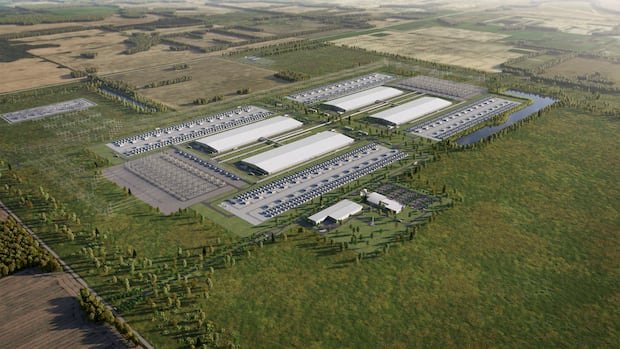
New York has taken a significant step by becoming the first state in the United States to halt the expansion of hyperscale data centers due to concerns regarding energy consumption and environmental impacts. Governor Kathy Hochul, a Democrat, expressed her commitment to taking decisive action by issuing an executive order that suspends the issuance of new permits for large data centers for a period of one year.
This decision has placed New York at the forefront of a national debate on regulating the enormous data centers that power artificial intelligence technologies. The debate has also extended to Canada, where communities are raising questions about the strain these data centers place on local power grids and water resources.
While Hamilton, Ontario, was considering a similar moratorium, the city council ultimately voted against it. Anne Pasek, an associate professor at Trent University specializing in data centers, highlighted concerns that many data center projects are being approved without sufficient public consultation.
Data centers serve as the infrastructure where companies store their computing resources, such as servers and storage drives. Hyperscale data centers, the largest type, typically house over 5,000 servers and cover more than 10,000 square feet of space. These facilities support not only artificial intelligence but also cloud computing services, which people interact with daily on platforms like social media and streaming services.
The rapid growth of AI technology has led to a surge in demand for computing power, with companies investing billions of dollars in infrastructure to capitalize on the technology’s potential. However, this expansion has raised concerns about the environmental impact of data centers, particularly in terms of energy consumption and water usage.
Data centers are known for their substantial energy consumption, accounting for approximately 1.5% of global energy usage in 2024, a figure projected to double by 2030. These facilities also require significant amounts of water for cooling purposes, with some using potable water, potentially straining local water resources.
The clustering of data centers in specific regions can have localized impacts on communities, including noise pollution and air pollution. As the demand for data centers grows, there are increasing concerns about their effects on local infrastructure and resources, such as power grids and water supply.
Although the United States leads in data center development, Canada has become an attractive destination due to its affordable electricity rates. Meta, for instance, announced plans to build a massive data center near Edmonton, its first in Canada. The country currently has five hyperscale data centers, with more in the pipeline, as identified by research from York University.
As the debate over data center expansion continues, various provinces and territories in Canada have different approaches to addressing the challenges posed by these facilities. While some jurisdictions welcome responsible data center investments, others are scrutinizing the potential impacts on their communities and resources.
In conclusion, the growing presence of data centers in Canada raises important considerations regarding environmental sustainability, resource management, and community impacts. Each region must carefully evaluate the benefits and risks associated with data center development to ensure responsible and sustainable growth in the digital infrastructure sector.

