
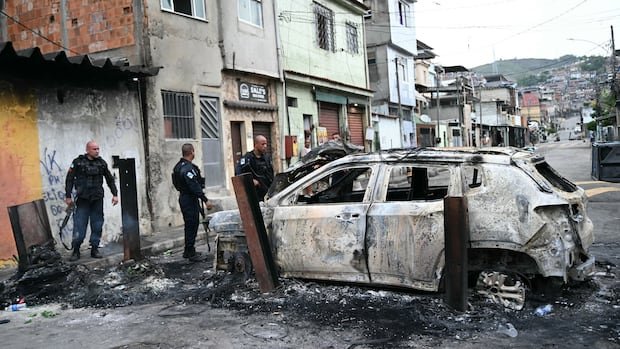
A police operation targeting a notorious gang in Rio de Janeiro resulted in a death toll of 119, including four officers, according to Brazilian authorities. The operation, conducted by 2,500 police and soldiers, took place in two low-income neighborhoods of the city and led to clashes. A total of 113 suspects were arrested, an increase from the initial count of 81. This operation has been described as one of the most violent in Brazil’s recent history, prompting calls for investigations by human rights organizations.
Justice Minister Ricardo Lewandowski expressed surprise at the high number of casualties and stated that the federal government was not informed in advance of the raids. President Luiz Inácio Lula da Silva was reportedly shocked by the outcome, leading Lewandowski to plan a meeting with provincial officials in Rio.
The operation, which involved helicopters and armored vehicles, targeted the Red Command gang in the favelas of Complexo de Alemao and Penha. It took place ahead of Rio hosting the C40 global summit on climate change. The event is a precursor to COP30, the United Nations climate summit scheduled for November in Belem.
The United Nations’ human rights body condemned the deadly police operation and called for thorough investigations. Human Rights Watch in Brazil labeled the events as a “huge tragedy” and emphasized the need for independent investigations into the circumstances of each death.
Social media footage showed fire and smoke rising from the favelas as gunshots were heard. Schools were closed, and university classes were canceled as a safety precaution. Suspected gang members reportedly blocked roads and commandeered buses in response to the raid.
The police operation followed a year-long investigation into the criminal group. Political figures expressed differing opinions on the government’s approach to combating crime, with some calling for increased support and others highlighting recent actions against organized crime. The Red Command criminal gang has been expanding its influence in Rio’s favelas in recent years.
Luis Flavio Sapori, a public safety expert, noted the unprecedented scale of the operation and criticized its efficacy in targeting lower-ranking members instead of masterminds. The Marielle Franco Institute, founded in honor of a slain councilwoman, condemned the operation as a policy of extermination that disproportionately affects marginalized communities.

