
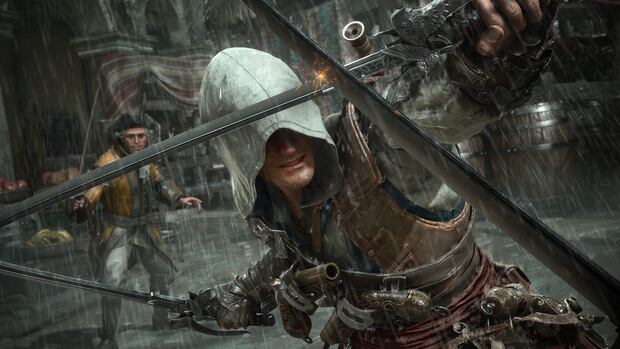
Ubisoft’s decision to remake Assassin’s Creed IV: Black Flag as the inaugural title in its extensive franchise is understandable.
Debuting in 2013, this swashbuckling adventure revitalized the time-traveling series after a lackluster third installment. It garnered praise from both critics and players.
Conversely, Black Flag is relatively recent in the realm of video games. It remains accessible on current consoles and PCs, unlike many older titles that have been remade due to their original versions being out of print and hard to obtain.
Remakes are currently a hot trend in the gaming sector, as investing in new titles appears riskier than in previous years. However, while the original Black Flag enjoys a devoted fan base, does that ensure that Assassin’s Creed Black Flag Resynced is a successful remake?
A technological advancement
At its essence, the narrative revolves around Edward Kenway, a Welsh privateer who becomes a pirate during the early 1700s, a time often referred to as the golden age of piracy. Initially, he aligns himself with the pirates’ republic in Nassau, a semi-autonomous region, before becoming embroiled in the conflict between the Assassins and Templars, two clandestine factions representing personal liberty and oppressive peace, respectively.
Technically speaking, Resynced is a completely reimagined iteration of Black Flag, crafted using Ubisoft’s Anvil engine, which is also the foundation for more recent entries in the Assassin’s Creed series.
The advantages of this technological upgrade are immediately noticeable: Resynced is visually stunning. Main characters exhibit realistic facial expressions during dialogue. The glassy eyes and unnatural skin sheen of the original have been replaced with lifelike lighting and shadow effects.
Kenway’s movements—running, climbing, and leaping off high structures—are fluid and polished, a leap forward that was groundbreaking in 2017’s Assassin’s Creed Origins and remains impressive today.
The hand-to-hand combat system has also seen enhancements. Kenway can now vault over opponents for surprise attacks and utilize a rope dart to pull enemies toward him, reminiscent of Scorpion’s iconic “Get over here” move in Mortal Kombat.
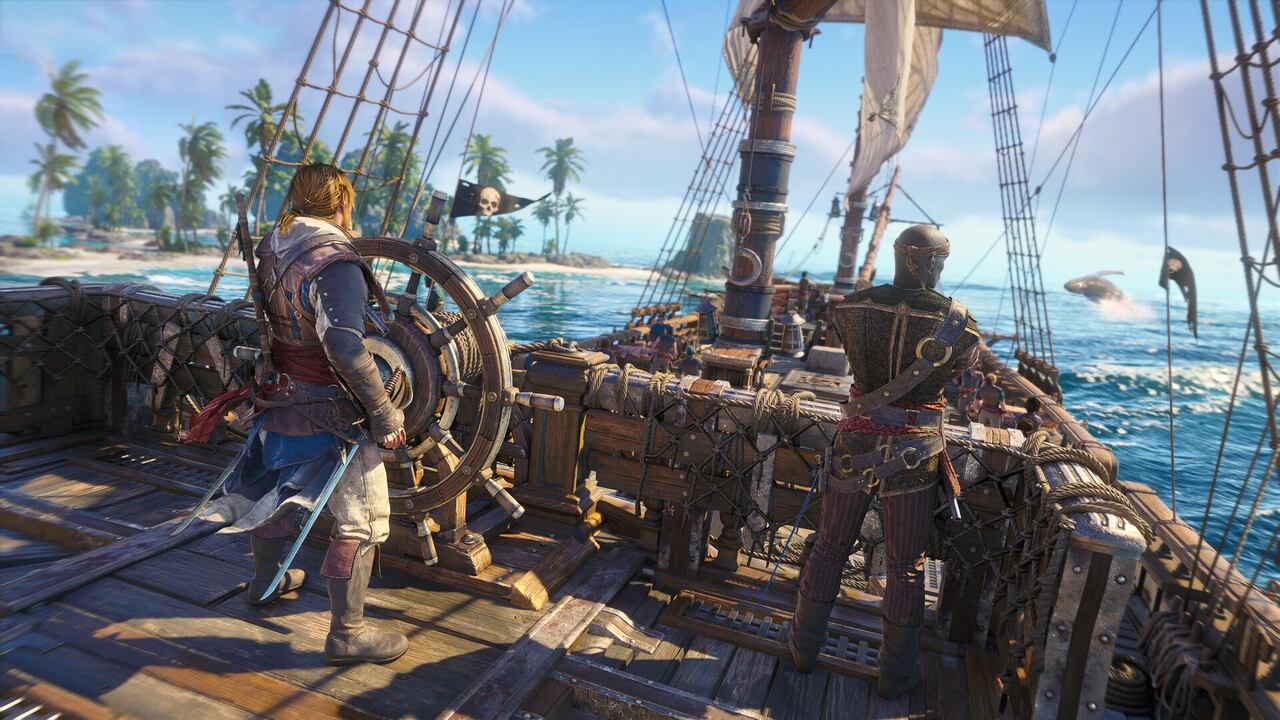
Much of your gameplay in Assassin’s Creed Black Flag Resynced will take place aboard the Jackdaw, as you navigate the West Indies around 1710, engaging in battles with English, Spanish, and Portuguese warships. (Ubisoft)
Persistent issues
Unfortunately, Resynced does not resolve numerous frustrations from the original game. Despite the combat system enhancements, it remains somewhat unenjoyable in practice.
The most challenging moments occur during ship boarding. The camera often struggles to focus amidst chaotic melee, with numerous characters crowding around each other. Enemies frequently attack from off-screen, making it difficult to react in time to defend against strikes.
Long-standing issues with running and climbing have also resurfaced. While pursuing a target across rooftops, you might find yourself awkwardly hanging from a balcony. Attempting to ascend a ship’s mast could result in an unintended leap into the ocean.
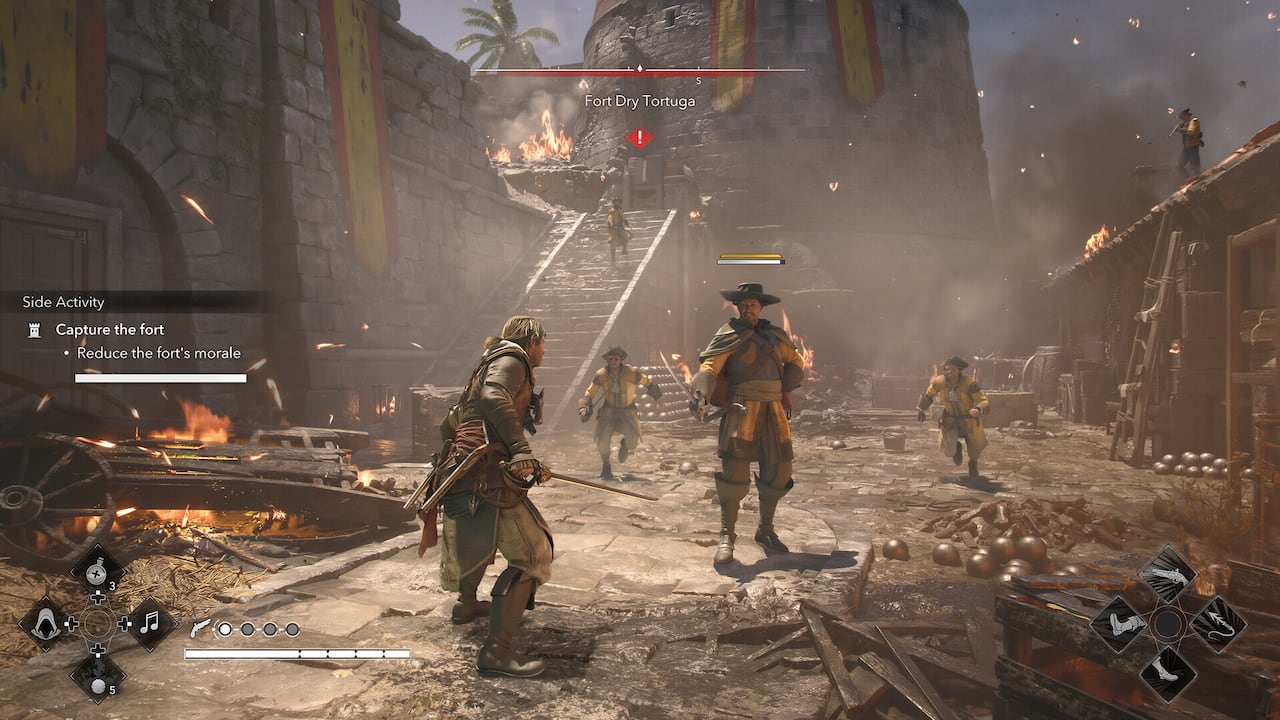
Although hand-to-hand combat has been upgraded in Black Flag Resynced, the larger battles remain a source of frustration. (Ubisoft)
While naval battles are a cherished aspect for many, I have never found them enjoyable, and Resynced has not altered my perspective. The ship-to-ship combat is visually appealing, but maneuvering the Jackdaw’s unwieldy hull can be tedious. Its size often leads to accidental collisions with other vessels or grounding on nearby shores.
Though it’s delightful when the crew sings shanties during calm waters, the lengthy travel times can shift the experience from peaceful to tedious. Unlocking fast travel locations that allow teleportation between islands became a relief, sparing me from having to navigate the same routes repeatedly.
A delightful but clumsily conveyed narrative
The majority of Black Flag‘s storyline can be viewed as a contemporary retelling of A General History of the Pyrates, which is the foundation for many well-known pirate tales — most of which are likely fictional.
Iconic characters like Edward “Blackbeard” Thatch, “the gentleman pirate” Stede Bonnet, and female pirates Mary Read and Anne Bonny make appearances in the game. Conveniently, they all serve as comrades, friends, or occasional allies to Kenway.

Blackbeard intimidates both friends and foes in Black Flag Resynced (Ubisoft)
Despite the vibrant cast, the game’s fragmented open-world design detracts from what could be a more unified story.
Players are free to traverse the map and pursue various plotlines in nearly any sequence. Only the primary missions adhere to a specific timeline, showcasing key moments from Edward’s life throughout the early 1700s.
The outcome is a disjointed collection of major plot events and independent narratives. It’s akin to watching a long-running television show out of sequence, leaving you with the impression that you might have missed an episode that would clarify a character’s motives prior to a significant twist or betrayal.
Prominent characters do not appear in optional storylines, as their roles may vary based on when players engage with them.

Players have the freedom to dive underwater anywhere in the West Indies, although there’s not much to discover aside from a few areas where they can hunt for sunken treasure. (Ubisoft)
Longtime fans of Black Flag may be particularly disheartened by the exclusion of two narrative threads: the contemporary interludes set within a Montreal gaming studio operated by the fictional nefarious company Abstergo, and the Freedom Cry epilogue, which followed Kenway’s lieutenant Adewale on his mission to liberate slaves throughout the West Indies.
In their stead, several new story arcs have been introduced, and it is within these that Resynced truly excels. Edward can enlist three new crewmates, including the grumpy shipwright Lucy Baldwin and a repentant pirate priest known as “The Padre,” whom players encounter early in the game.
Their relatively brief quests render them some of the most well-developed characters throughout the game. Two short chapters focusing on Blackbeard and Bonnet are particularly well-written, providing unexpectedly profound insights into their characters.

Black Flag Resynced features several new crewmates with their own side story episodes, including shipwright Lucy Baldwin. (Ubisoft)
Farewell and best wishes
Thus, we circle back to the initial inquiry: While Black Flag Resynced is, for the most part, a very good game, does it qualify as a good remake?
It resembles more of a director’s cut than a complete reimagining, with the primary modifications being technical rather than narrative in nature.
Newcomers to the series may find more recent titles like Valhalla and Shadows to be more user-friendly. Nevertheless, the historically rich era of piracy remains one of the series’ finest backdrops, and Edward continues to be one of its most compelling protagonists.
Assassin’s Creed Black Flag Resynced is currently available on Xbox Series X&S, Sony PlayStation 5, and Windows PC.

