
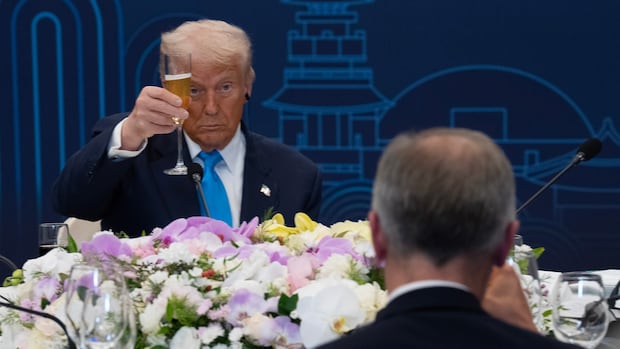
During a dinner prior to the Asia-Pacific Economic Co-Operation Summit on Wednesday, U.S. President Donald Trump and Prime Minister Mark Carney were positioned opposite each other and even exchanged acknowledgments during a toast. However, their interaction seemed limited, highlighting the chill in U.S.-Canada relations.
This marked the first direct encounter between the two leaders since Trump scrapped trade discussions in response to an anti-tariff advertisement aired by the Ontario government.
Following the dinner, the prime minister, reacting to a question shouted by a Global News reporter, mentioned he had engaged in “very good conversations with all the presidents” present.
Upon arriving in South Korea, Carney faced a stark reminder of his challenges with the U.S., as Air Force One was stationed on the tarmac adjacent to his plane.
As Canada approaches the APEC conference, it finds itself in a precarious situation, where Carney aims to mend the nation’s ties with China, among other objectives.
On one side, there is the clearly worsening dynamic with Trump, who has declined to engage with Carney and has halted trade negotiations. On social media, Trump remarked on Wednesday that he did not travel all the way to South Korea to converse with Canada.
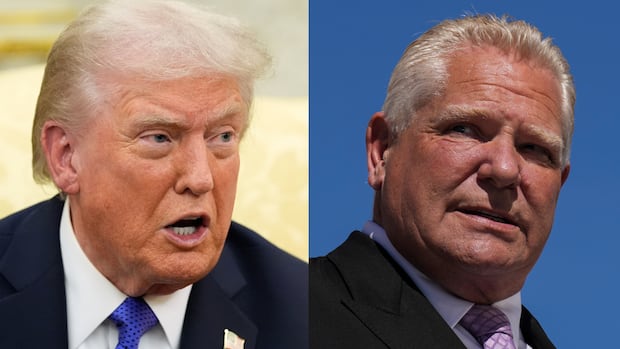
U.S. President Donald Trump announced he would be terminating all trade negotiations with Canada after an anti-tariff ad by the Ontario government was broadcast to American audiences. In response, Ontario Premier Doug Ford said he will pull the ad Monday, after it airs during the weekend’s World Series games.
Simultaneously, Carney is tasked with the sensitive goal of broadening trade relations, a challenge that requires dialogue with Beijing, the world’s second-largest economy and also a significant competitor to the U.S.
Any potential concessions Canada might consider to revitalize its relationship with China, such as re-evaluating electric vehicle tariffs, are likely to face heightened scrutiny or even outright opposition in Washington.
The China conundrum
Trump seems poised to enter APEC prepared to make trade concessions or at least modify tariffs to facilitate a broader agreement with China.
The extent of Carney’s flexibility to pursue similar actions remains uncertain.
Reports ahead of Trump’s meeting with Chinese President Xi Jinping indicate that Washington might lower tariffs on Chinese goods in exchange for China’s commitment to implement more stringent controls on chemicals used in fentanyl production.
An expert advised caution regarding the pre-summit media frenzy, noting that, as demonstrated by Canada, the U.S. trade landscape can quickly shift in unexpected ways.
“Trump has a favorable view of Xi, so there will likely be considerable hype following this meeting suggesting that the U.S.-China relationship is improving,” stated Jonathan Berkshire-Miller, a principal at Pendulum Geopolitics Advisory.
“I would urge caution in believing that narrative, as the relationship could take a downturn just days or weeks later.”
In his upcoming meeting with Xi on Friday, Carney will need to tread carefully to avoid upsetting Trump and to remember that China’s approach to foreign policy may not align with conventional geopolitical norms, Berkshire-Miller added.
“Not suggesting we base our policies solely on the U.S., but if any significant outcomes from that meeting involve removing EV tariffs as a form of retaliation, it could present a weak stance from our side,” Berkshire-Miller remarked.
Ottawa imposed EV tariffs on Chinese imports at the request of the U.S., which prompted China to retaliate with tariffs on Canadian canola.
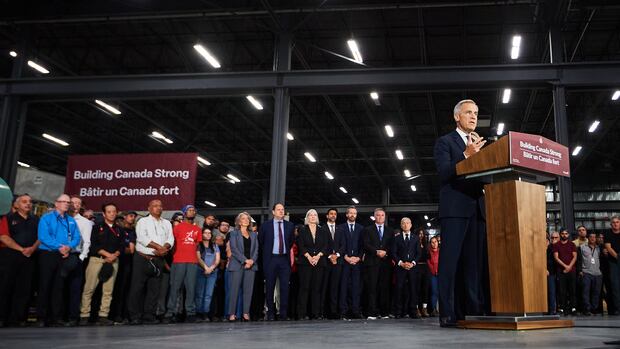
Prime Minister Mark Carney said his government is taking a series of measures to increase Canada’s ‘climate competitiveness’ across the economy, and that includes a broad ‘restructuring’ of the auto sector. He said it’s too early to say if tariffs on Chinese EVs would be removed.
“China does not perceive its foreign policy tools in the same manner we do, and the moment [China] feels the need to utilize any of those economic tools, it will do so, potentially against our interests.”
Summit a ‘great opportunity’ for Carney
When addressing questions earlier this week concerning the anticipated meeting with China, Carney tempered expectations for a significant breakthrough.
The U.S. will not be the sole observer of how Carney navigates his discussion with Xi. Other Indo-Pacific allies, many of whom the prime minister met with earlier in the week at the ASEAN summit, will also be closely watching.
There is considerable doubt among Asian nations regarding Canada’s genuine commitment to diversifying trade beyond the U.S., Berkshire-Miller noted, along with concerns about how improving relations with China could impact trade and their increasing need for security assurances.
“The region desires more than mere trade,” stated Berkshire-Miller.
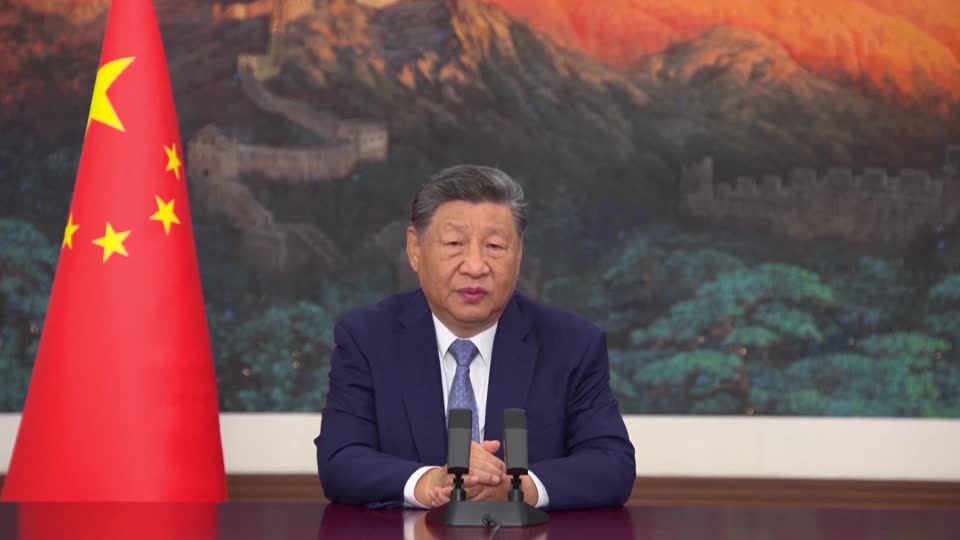
Chinese President Xi Jinping is seen at a United Nations climate summit in September. Canadian Prime Minister Mark Carney is expected to meet with Xi at the Asian economic summit on Friday. (Reuters)
To emphasize this point, South Korea’s acting ambassador to Canada recently indicated in an interview with Radio-Canada that Carney’s visit, which includes a stop at the Hanwha Ocean shipyard — one of the bidders for Canada’s submarine replacement program — sends a strong signal of commitment.
“This also presents a significant opportunity for Prime Minister Carney to reaffirm and highlight Canada’s dedication to the Asia Pacific region and its partnership with Korea,” remarked Young-gi Ahn, the Korean chargé d’affaires in Ottawa.
“Amid heightened global challenges and geopolitical uncertainties, Korea and Canada require each other. We can be dependable partners.”
While Carney has leveraged his extensive network of high-profile business contacts in the region over the past few days — securing meetings with the prime minister of Singapore, the CEO of Petronas, and the chairman of Temasek Holdings, one of the largest private equity firms globally — the U.S. and China have been racing to finalize new agreements or strengthen their trading connections in the region.
Trump has signed numerous deals with various countries to secure access to the supply of rare earth minerals, a vital sector where China has long held dominance and which is crucial for advanced manufacturing.
Agreements of varying scopes were established with Japan, Malaysia, Thailand, Vietnam, and Cambodia. This is a focused and clear effort to lessen reliance on China ahead of Trump’s meeting with Xi.
Two days following Trump’s departure from the ASEAN gathering, China announced an upgraded free trade agreement with the group of eleven countries, aimed at enhancing cooperation in areas such as transportation, digital trade, the green economy, sustainability, and disaster prevention, among others.

