
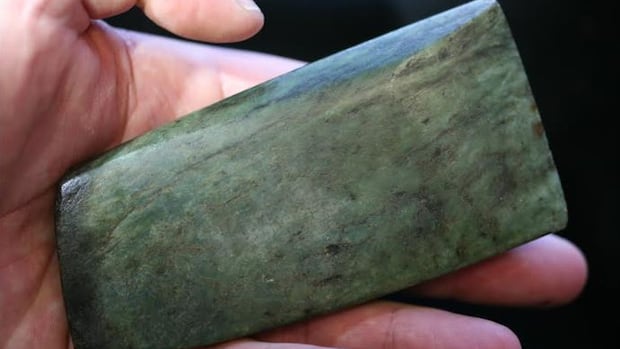
Recent studies examining jade artifacts discovered east of the Rocky Mountains provide insights into extensive Indigenous trade networks that existed across pre-colonial Western Canada.
Over a span of more than 3,000 years, nephrite jade was meticulously hand-polished and shaped into tools such as blades, chisels, and axe heads.
For the central and coastal Salish groups in the Pacific Northwest, these tools—crafted from a remarkably resilient stone available in various hues like emerald green, black, yellow, and white—were vital everyday implements for carving wood essential to their daily lives.
Interestingly, some of these stone tools made their way from their quarry sites in British Columbia across the Rocky Mountains, eventually being discovered in locations such as Alberta, Saskatchewan, and Manitoba.
The Archaeological Survey of Alberta, based in Edmonton, spearheaded a peer-reviewed study on these tools, which was recently featured in North American Archaeologist. The research team included scholars from the University of Alberta, University of British Columbia, University of Saskatchewan, and the Royal Saskatchewan Museum.
Their research indicates that these tools, referred to as stone celts, were highly sought-after prestige items in the Prairie regions.
Originating from what is now British Columbia, these artifacts were transmitted to Dene and Cree communities located east of the Rockies through extensive pre-contact trade networks that transcended cultural and linguistic divisions.
The widespread presence of these artifacts signifies the establishment of large social networks among Indigenous populations across Western Canada, according to Todd Kristensen, regional archaeologist with the Archaeological Survey of Alberta and lead author of the study.
“By the time it reached the eastern side of the Rockies about 1,000 years ago, jade had shifted in significance from being a practical tool to a means of reinforcing social ties and networks—a kind of gift,” he explained.
‘The mystery’
The research aimed to resolve questions that have persisted in anthropology for many years. While the use of nephrite by pre-contact peoples in British Columbia is well-documented, its occurrence east of the Rockies has been largely overlooked, Kristensen noted.
Considering the absence of local nephrite sources or evidence of local production in the Prairie regions, researchers sought to identify the origins of these artifacts and the manner in which they came to be there.
“In British Columbia, these tools were utilized for crafting cedar dugout canoes and various woodworking tasks,” Kristensen remarked. “In Alberta and Saskatchewan, where some of these jade celts have been located, the context is entirely different.
“This presented a mystery. Why do we find these jade artifacts in places where it appears the jade was not needed functionally?”
The researchers examined 24 nephrite celts documented east of the Rockies over the last 75 years. They verified their mineral composition and source using portable X-ray fluorescence, gamma spectrometry, and specific gravity testing.
The findings confirmed that all specimens originated from the Fraser River area in British Columbia.
On average, the study revealed that these celts traveled nearly 850 kilometers from their source, with some having journeyed almost 1,500 kilometers.
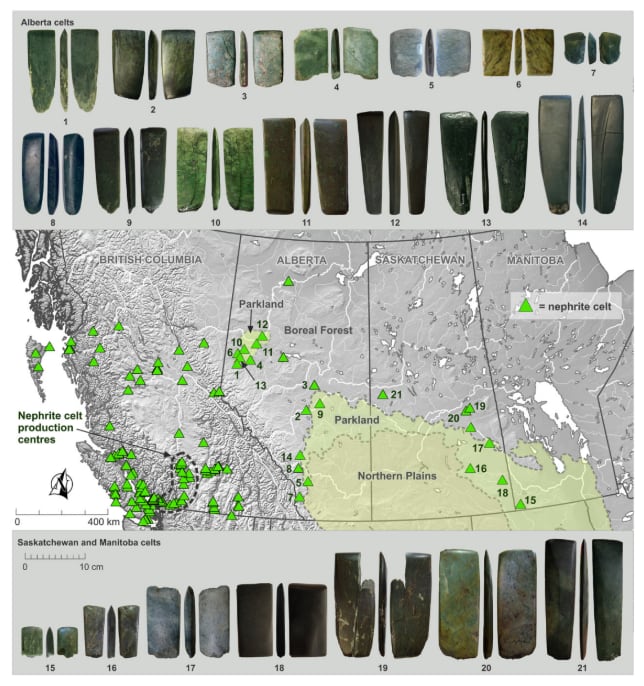
This graphic from the Archaeological Survey of Alberta details all known locations where jade stone celts have been found east of the Rocky Mountains. (Archaeological Survey of Alberta)
The study proposes several potential routes these items may have taken across the continent.
It suggests that Interior Salish artisans could have traded with nearby Dene groups, who then transported the celts eastward across the Rockies to share with Dene relatives and ancestral Cree communities.
Additionally, Dene groups traveling west from northern Alberta for trade events at the Fraser River may have acquired the celts and brought them back home, or Salish groups making eastward trips into Alberta’s mountain river valleys might have traded directly with western Dene communities.
“We believe that Dene migrations through the area led to the establishment of new relationships that facilitated the eastward movement of jade across the Rocky Mountains,” Kristensen stated.
“Jade could be seen as a key indicator of a new economic relationship that altered the distribution of goods.”
‘Beautiful object’
Creating a nephrite celt demanded significant labor in grinding and polishing. A smaller celt often required over 100 hours to produce, while larger versions might take up to 500 hours.
“Investing 100 hours in crafting an object imbues it with substantial meaning and worth,” Kristensen remarked.
Celts in the Pacific Northwest were frequently re-sharpened and reused as tools for generations. However, those discovered by archaeologists in parklands and boreal forests, where communities relied on lighter materials like birch bark and hide instead of heavy timber, were significantly larger and showed little signs of wear.
This indicates that as the stone celts traveled further, they were no longer utilized as functional tools but had transformed into symbols of prestige.
Kristensen likens them to cherished items that someone might display on a desk or mantelpiece today.
“It’s an exquisite object, but the true value lies in the relationships that facilitated its journey,” he stated.
Typically, pre-contact populations are depicted as isolated hunter-gatherers, yet this study presents a different narrative, according to Kristensen.
“We often envision people as merely adapting through hunting and gathering sufficient tools and resources for survival. However, fostering relationships was equally vital,” he explained.
“This jade study helps illuminate that aspect.”
Kisha Supernant, director of the Institute of Prairie and Indigenous Archaeology at the University of Alberta, remarked that this research challenges the notion of pre-contact Indigenous groups as isolated, instead illustrating the human connections and long-distance travels that occurred across the western landscape.
Supernant commended the researchers for their collaboration with Indigenous communities and for linking their findings to the broader context of pre-contact Indigenous cultures.
“This adds a human dimension, which is crucial, as archaeology fundamentally seeks to understand the people of the past,” she noted.
Kristensen highlighted that the study significantly relied on citizen science, as nearly all 24 artifacts were originally discovered by farmers tilling their fields rather than through formal archaeological digs.
Looking ahead, he mentioned that the research team intends to collaborate with Indigenous communities to integrate their findings with traditional oral histories.

