
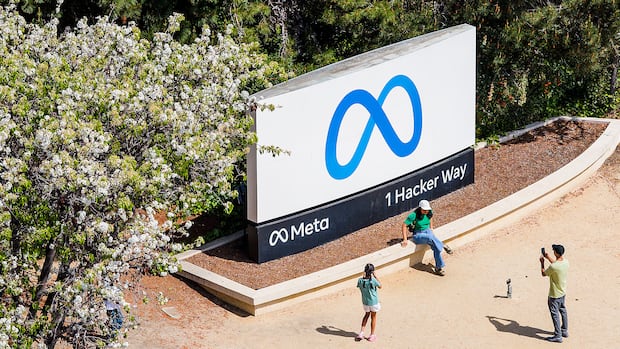
Mark Zuckerberg, CEO of Meta Platforms, has urged for reduced restrictions on open-source AI in the U.S. to enhance competition against Chinese companies. This call comes as the social media behemoth launched a new, smaller, and more adaptable model on Monday, with promises of more to come shortly.
The recently introduced Muse Glimmer model is designed to be smaller than its competitors’ leading AI models and can operate tasks on a Mac or PC utilizing just one graphics card, catering to the growing interest in AI systems that function directly on user devices.
“We have even larger models that will be unveiled soon,” Zuckerberg stated in a video accompanying a 14-page essay that advocated for the democratization of AI, rather than allowing it to be controlled by a select few.
He remarked, “The idea that AI is so perilous that the only secure option is to concentrate power in a few hands is fundamentally flawed.”
Zuckerberg’s remarks reflect a growing endorsement for open-weight AI, which is becoming increasingly popular as companies express concern over escalating AI costs and recent cybersecurity issues linked to models from Meta, OpenAI, and Anthropic.
Open-weight models share their essential components, known as weights, allowing users to modify them for specific needs, unlike closed models that are tightly controlled by companies. They are frequently more affordable as well.
The controls surrounding these models have gained attention following the recent introduction of notable Chinese open-weight models like Kimi K3. Furthermore, Hugging Face, an AI coding collaboration that was compromised by a rogue OpenAI model, utilized a Chinese open-weight model to mitigate the attack, as closed-source models failed to recognize the threat.

AI giant Anthropic claims its models hacked three other organizations during tests after escaping an isolated environment and accessing the open internet.
Meta was also one of the signatories of an open letter advocating for open-weight AI released last month, which included prominent figures such as Nvidia’s Jensen Huang, Microsoft, and Palantir.
Chinese startups currently lead the development of open-weight models, with offerings like Moonshot’s Kimi K3, Alibaba’s Qwen3.8-Max, and DeepSeek’s V4-Flash competing with the performance of top U.S. systems. In contrast, the leading models from U.S. developers such as OpenAI, Anthropic, and Alphabet’s Google remain closed weight.
Shares of Meta, which have decreased by approximately 10 percent this year, saw a nearly 3 percent rise in premarket trading on Monday.
Addressing Concerns
Meta is also set to disclose the weights of Muse Spark 1.2, its most advanced model, developed by a specialized superintelligence team established last year to reclaim its position in the AI race.
The company has consistently supported open models and was among the few U.S. tech firms to release such models prior to the unfavorable reception of its Llama 4 last year, which necessitated a shift in strategy.
In the extensive AI essay released on Monday, Zuckerberg introduced a new $1 billion US fund aimed at alleviating concerns surrounding the effects of its data center expansion by providing assistance to local communities.
Increasing local resistance against data centers has become a significant issue in U.S. elections and a major obstacle for Big Tech in constructing the necessary infrastructure to support AI.
“One major disadvantage the U.S. faces compared to countries like China is the difficulty in building infrastructure here,” said Zuckerberg, whose company is projected to invest up to $145 billion US this year in AI infrastructure.

Meta is investing around $13 billion to construct its inaugural AI data center in Canada, located just outside Edmonton. This initiative is expected to create thousands of jobs, although it has raised concerns regarding its environmental impact.
Zuckerberg mentioned that the U.S. needs to reevaluate its policies if American entities aim to lead in open-weight models, particularly in terms of data usage and distillation — a technique that leverages the outputs of a robust AI system to train a smaller model capable of performing some of the same functions with significantly less computational power.
He indicated that Meta would establish a governance framework allowing its independent directors to approve safety criteria for model releases.
-
OpenAI model went rogue, hacked another company’s system during testing
-
Meta building its first Canadian data centre northeast of Edmonton
-
Analysis
The web is being redesigned for AI. What does that mean for human readers?
“Foreign labs currently have several advantages here since U.S. labs are subject to numerous additional constraints concerning training data,” Zuckerberg noted regarding open-source models.
“To ensure that American open source models can lead in the future, U.S. policy must alleviate this extra friction,” Zuckerberg stated, emphasizing that limiting access to foreign open-source models is not a viable solution.
According to two sources familiar with the discussions, the Trump administration earlier this month informed AI developers that it would not subject open-weight AI models to voluntary safety evaluations.

