
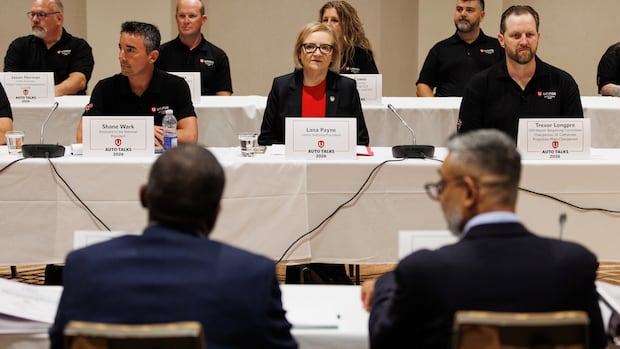
Unifor and General Motors have initiated discussions for a new labor agreement, commencing at a bargaining session in downtown Toronto on Monday.
The union represents over 4,600 members working at GM facilities across Ontario, which include the Oshawa assembly plant, the CAMI plant in Ingersoll, and operations in St. Catharines and Woodstock.
To signify the start of the negotiations, Unifor national president Lana Payne and Jack Uppal, president and managing director of GM Canada, shook hands.
The conference room was arranged with chairs facing each other, with Payne positioned in the center and Uppal directly opposite.
“We are entering this new round of negotiations with a strong foundation established by the pattern agreement with Ford, and we aim to engage in meaningful discussions regarding company operations and the future of auto jobs at GM in Canada,” Payne stated in a news release on Monday.
The union has set a target date of August 21 to finalize a tentative agreement with GM.
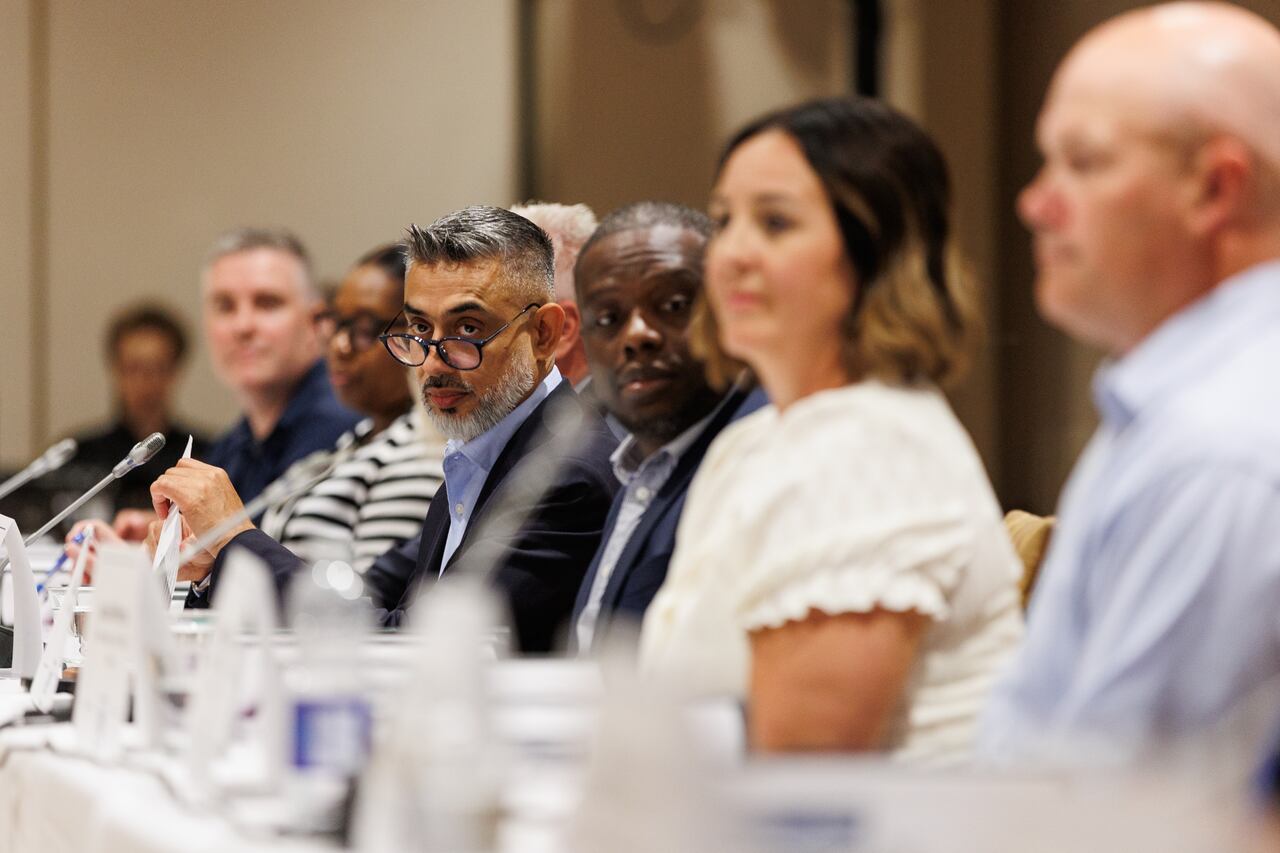
Jack Uppal, center left, president and managing director of GM Canada, is seen with GM representatives as they work towards Unifor’s target deadline of August 21. (The Canadian Press)
Uppal emphasized in a news release that the company approaches these negotiations with “deep respect for the collective bargaining process” and acknowledges the vital role its employees have in the company’s success.
“Since 2020, we have invested $3.3 billion into our Canadian manufacturing plants, promoting next-generation products that will sustain thousands of Canadian jobs for years ahead, and our aim is to achieve a mutually advantageous agreement that supports our workforce while ensuring GM Canada remains competitive in the long term,” he added.
In July, Unifor members ratified a new three-year agreement with Ford that featured annual pay raises of three percent.
Additional components of the agreement, which takes effect on September 21, included a renewal of a no-closure clause.
The contract also included commitments for programs at all Ford locations, including a forecasted third shift at the Essex engine plant expected to begin in 2029.
Unifor and Ford establish program for laid-off workers
Unifor and Ford have also agreed to implement a program that offers laid-off workers from the Oakville, Ontario assembly plant a pathway to full employment by July 2027.
The union states that the agreement with Ford represents successful pattern-setting negotiations.
Pattern bargaining involves a union negotiating with one company to establish terms that it seeks to replicate with other companies within the same industry.
Ford employees covered by the master agreement voted 74 percent in favor of the deal, while members from two local unions voted 97 percent and 100 percent in support.
Unifor national president Lana Payne mentioned in an interview at that time that the deal with Ford set a precedent with significant advancements in wages and job security.
“I have confidence in our negotiations here because history has shown us that if we encounter challenges, we can find ways to navigate through them,” Payne remarked at that time.
-
Unifor to begin bargaining with Ford in June as it seeks model for new collective agreements
-
Unifor members ratify new deal with Ford Motor that includes wage increases, new investment
Nonetheless, she acknowledged that there are distinctions between Ford and its automotive counterparts – General Motors and Stellantis – which could complicate future negotiations.
Specifically, the Ingersoll assembly plant at General Motors and the Brampton assembly plant at Stellantis are currently inactive, resulting in thousands of workers being laid off.
“The difference lies in the decisions they have made, which have varied from those of Ford Motor Co. over the last 18 months,” Payne noted, referring to the period of trade uncertainty that has arisen since the implementation of auto tariffs.
“I am certain that these contract negotiations will also present challenges and could be quite frustrating. However, we must advocate for this industry here, and this is one of the methods we can pursue that goal.”
The ongoing bargaining between Unifor and the remaining Detroit Three automakers coincides with several headwinds facing the industry.
The union has previously highlighted issues such as U.S. tariffs, the Trump administration’s choice not to extend the Canada-United States-Mexico Agreement, and the influx of Chinese electric vehicles into the Canadian market.
Tag: rewrite-pending

