
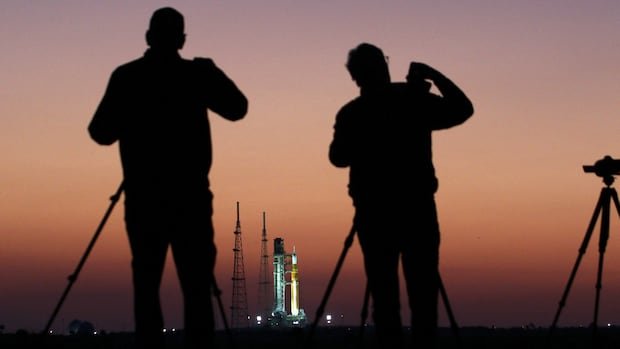
Artemis II is gearing up for its upcoming voyage around the moon and back, marking a potential record-breaking journey into deep space for human exploration. The mission will feature Canadian Space Agency astronaut Jeremy Hansen alongside NASA astronauts Reid Wiseman, Victor Glover, and Christina Koch, all set to embark aboard the Space Launch System (SLS) rocket and the Orion spacecraft from Kennedy Space Center’s Launch Pad 39B in Florida.
The mission’s launch schedule presents various opportunities based on risk assessments and system checks. Previous launch attempts in February and March were postponed due to technical issues involving hydrogen and helium, along with weather considerations. However, NASA has indicated an “80 per cent go” status for the planned launch on April 1. To achieve the required orbital trajectory, the launch is scheduled for the evening, with the first window set for Wednesday, April 1, from 6:24 p.m. to 8:24 p.m. ET. Subsequent launch opportunities are available nightly from April 2 to April 6 in case of any delays.
For detailed insights into the critical minutes leading up to liftoff, NASA offers a comprehensive breakdown. CBC News will provide extensive coverage of the mission, with reporters stationed at Kennedy Space Center to deliver updates and highlights across various media platforms. Online coverage will commence two hours before the launch on CBCNews.ca, featuring a live stream of the event and real-time updates.
While Artemis II aims to orbit the moon without landing, the mission serves as a pivotal test for essential systems with crew members on board. Originally intended as the final test before Artemis III’s lunar landing in 2028, NASA’s plans have evolved, with Artemis IV now slated for a moon touchdown. The Artemis missions aim to establish a sustained presence for scientific exploration and economic activities on the moon, laying the groundwork for future Mars missions.
The urgency to accelerate space exploration efforts stems from NASA’s ambition to reclaim leadership in space initiatives, with plans to expedite moon base development and reassessing the Lunar Gateway concept. This drive is fueled by the progress made by other nations, such as China, in advancing their lunar exploration programs. With Artemis II set to span approximately 10 days before concluding with a splashdown in the Pacific Ocean, the mission represents an essential step in NASA’s broader space exploration objectives.

