
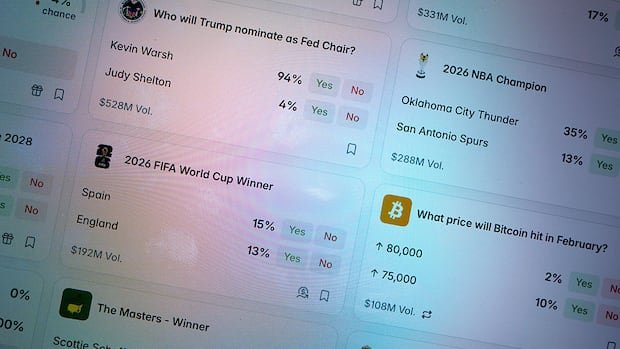
A recent study suggests that individuals looking to profit from prediction markets in Canada may face challenging odds. These markets, such as Polymarket and Kalshi, enable users to speculate on real-world events by trading contracts related to economic indicators, financial markets, and climate patterns. In Canada, these markets are primarily limited to events within these categories, like “Will there be a Bank of Canada rate hike in 2026?” and “Will any month of 2026 be the hottest on record?”
Unlike traditional gambling establishments, prediction markets do not have a house to bet against. Instead, participants compete against each other, with the platforms generating revenue through small transaction fees on each wager. A recent research paper by experts from Yale University and London Business School found that only about three percent of Polymarket users, known as “skilled traders,” consistently made profits and accurate predictions. These gains were primarily funded by a larger group of losing traders.
As these prediction markets prepare to enter Canada through a partnership between Wealthsimple and Kalshi, experts emphasize the importance of understanding the competition. Roberto Gómez-Cram, co-author of the study and a finance assistant professor at London Business School, stresses the necessity for traders to possess sophistication and expertise to navigate these markets successfully.
The research, which leveraged data from Polymarket, analyzed $13.76 billion US in trading volume across 1.72 million accounts. It revealed that nearly 70 percent of the trading volume originated from less-skilled traders, indicating that the profits of successful traders are largely funded by the mistakes of the majority. The absence of a house to bet against necessitates a substantial trade volume for these markets to operate effectively.
Top traders in these markets exhibit skills such as rapid news processing, consistent trading experience, and sometimes advanced programming knowledge. They utilize algorithms to inform their trades and conduct in-depth research to enhance their predictive models. Skilled traders engage in a systematic approach that evolves over time with experience.
The study also highlights that skilled traders leverage computer programming skills, poll data, and crowd-sourced investment analysis platforms to trade against the crowd’s errors, honed by years of economics experience. They remain abreast of political and financial developments, focus on understanding probabilities, and maintain diversified trade portfolios for success in these markets.
Prediction markets have witnessed a significant surge in popularity, with trading volume escalating from $100 million US in 2024 to $24 billion US in 2026. Financial firms have begun recruiting skilled traders to engage in contracts linked to central bank decisions and macroeconomic events. These firms prioritize analytical prowess over gambling instincts in their traders.
Amidst this growth, concerns arise regarding misperceptions of prediction markets as an easy route to financial gain. Experts caution that individuals should view participation in these markets as entertainment rather than a guaranteed profit opportunity. Luis Seco, a mathematical finance professor at the University of Toronto, advises caution, emphasizing the dominance of hedge funds in these markets and the challenges retail investors may face against seasoned professionals.
Seco underscores the importance of vigilance for individuals interested in prediction markets, emphasizing the market’s domination by large players and the risks retail investors may encounter. He warns against the illusion that these markets offer easy wins, urging careful consideration before engagement.

