
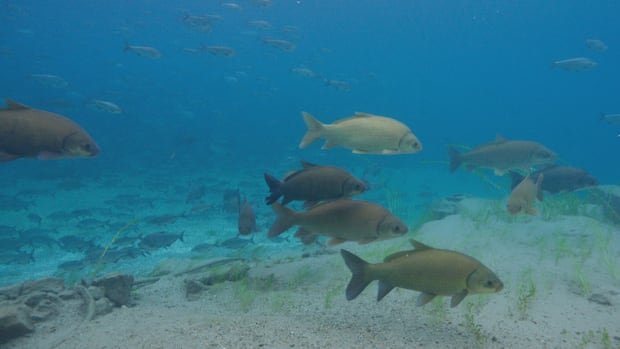
In the depths of Lake Huron, mesmerizing underwater scenes have captured the attention of a documentary crew, labeling a specific area as “fish city” and featuring it in honor of Earth Day. However, the Saugeen Ojibway Nation (SON) is challenging this portrayal, asserting that the warm-water outflow from the Bruce Nuclear Generating Station is more of a “fish trap” than a bustling fish metropolis.
SON highlights the tragic incident in 2025 where up to five million gizzard shad perished near the station, an event documented by the Department of Fisheries and Oceans (DFO) in a report from the Canadian Nuclear Safety Commission. This mass mortality occurred when an influx of fish congested the cooling water intake systems, prompting the shutdown of Bruce A Unit 2 by the utility. Additionally, SON reveals that several lake sturgeon, an endangered species with cultural significance in Anishnaabe traditions, became stranded at the plant, with only one being rescued thus far.
The debate surrounding “fish city” extends beyond mere imagery, raising concerns about how Bruce Power handles ecological risks as it pursues regulatory approval to enhance plant capacities for increased electricity production. Bruce Power, North America’s largest nuclear facility, releases warmer water into Lake Huron as part of its cooling process, attracting fish to the area. While regulatory bodies did not directly attribute the plant to the 2025 fish mortality, biologist Ryan Lauzon of SON underscores the dual nature of the site, acting as both a lure and a trap for fish.
Contrary to SON’s assertions, Bruce Power refutes any causal link between the plant and the 2025 die-off, attributing the incident to environmental factors such as high shad populations and severe winter conditions. The utility has implemented various measures, including nets and monitoring systems, to prevent fish entrapment in its infrastructure post the incident. Moreover, as Bruce Power seeks approval to boost electricity generation, it emphasizes the necessity of meeting rising energy demands safely within environmental constraints.
Acknowledging the lack of clear benchmarks for assessing fish deaths at intake sites, Bruce Power operates under stringent regulations without defined thresholds for acceptable fish losses. The company’s 2024 report underscores the absence of standardized criteria, emphasizing the reliance on population knowledge and variability to gauge environmental risks. Retired fisherman and councilor Paul Jones of the Chippewas of the Nawash Unceded First Nation underscores the ecological and cultural significance of fish, particularly the gizzard shad, within the lake ecosystem.
Jones stresses the interconnectedness of fish species in maintaining lake health, emphasizing the impact of the shad die-off on the broader ecosystem. From an Indigenous perspective, fish hold spiritual and practical importance, underscoring the need to address ecological disruptions rather than celebrating them.

