
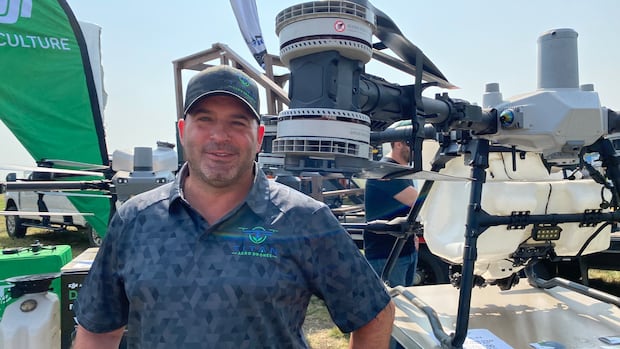
In the previous year, salesman Ryan Crumly forecasted that once drone usage for spraying insecticides and fungicides became legal, farmers would eagerly adopt the technology.
He seems to have been correct.
At the close of June, Health Canada lifted its prohibitions, permitting drones to apply authorized pesticides. This shift has “opened the floodgates” for farmers interested in the technology, according to Crumly, who is employed by Titan Aero Drones.
“My phone has never been busier,” he remarked.
“We probably had around 80 drones, and they were sold out within days.”
Both farmers and drone vendors applaud the regulatory change, arguing that drones can outperform traditional ground sprayers and aircraft. The interest in pesticide-spraying drones is projected to be considerable, with numerous farmers indicating plans to purchase one in the near future.
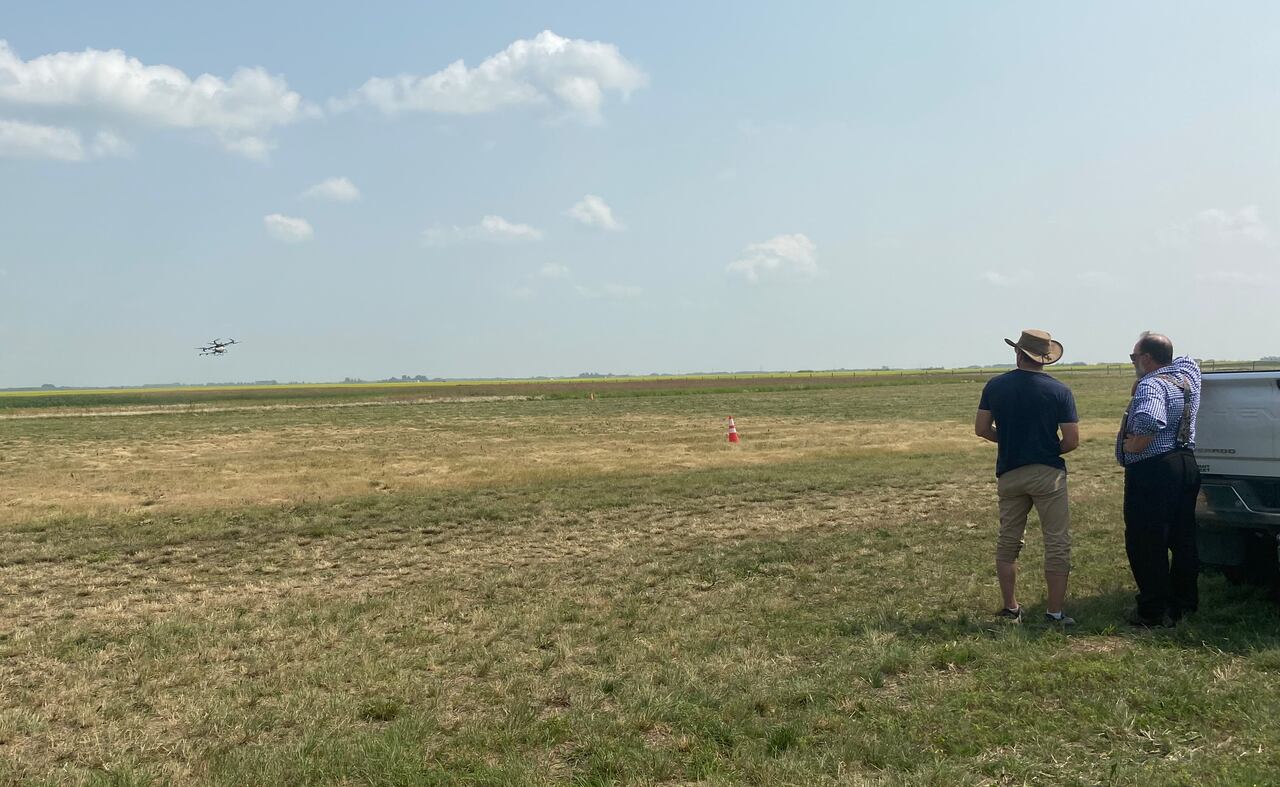
Two attendees of the Ag In Motion convention observe a drone demonstration on July 22, 2026, in Langham, Sask. (Maia Tustonic/CBC)
‘You’re just a babysitter’
Drones designed for pesticide spraying are promoted as a cutting-edge technology with numerous advantages.
For instance, they outperform planes and helicopters, which are restricted to daytime flights and cannot maneuver close to trees or power lines, Crumly explained.
This year, he has also received feedback from farmers particularly interested in drones due to flooding conditions causing their ground sprayers to become bogged down.

Artificial intelligence is being utilized across nearly all industries, and agriculture is no exception. Numerous new technological advancements will be showcased at Ag in Motion, Western Canada’s largest farm expo located just 15 minutes northwest of Saskatoon in Langham. Professor Steve Shirtliffe spoke with Saskatoon Morning host Candice Lipski.
Additionally, Crumly noted that they are user-friendly. Farmers can specify the areas and patterns for spraying, and the drone operates mostly on its own.
“You’re merely a babysitter who changes batteries and refills the tank,” Crumly stated.
Greg Hill, who manages a farm and ranch in southeast Saskatchewan, expressed that he anticipates drones will have a “significant impact” on the agricultural sector.
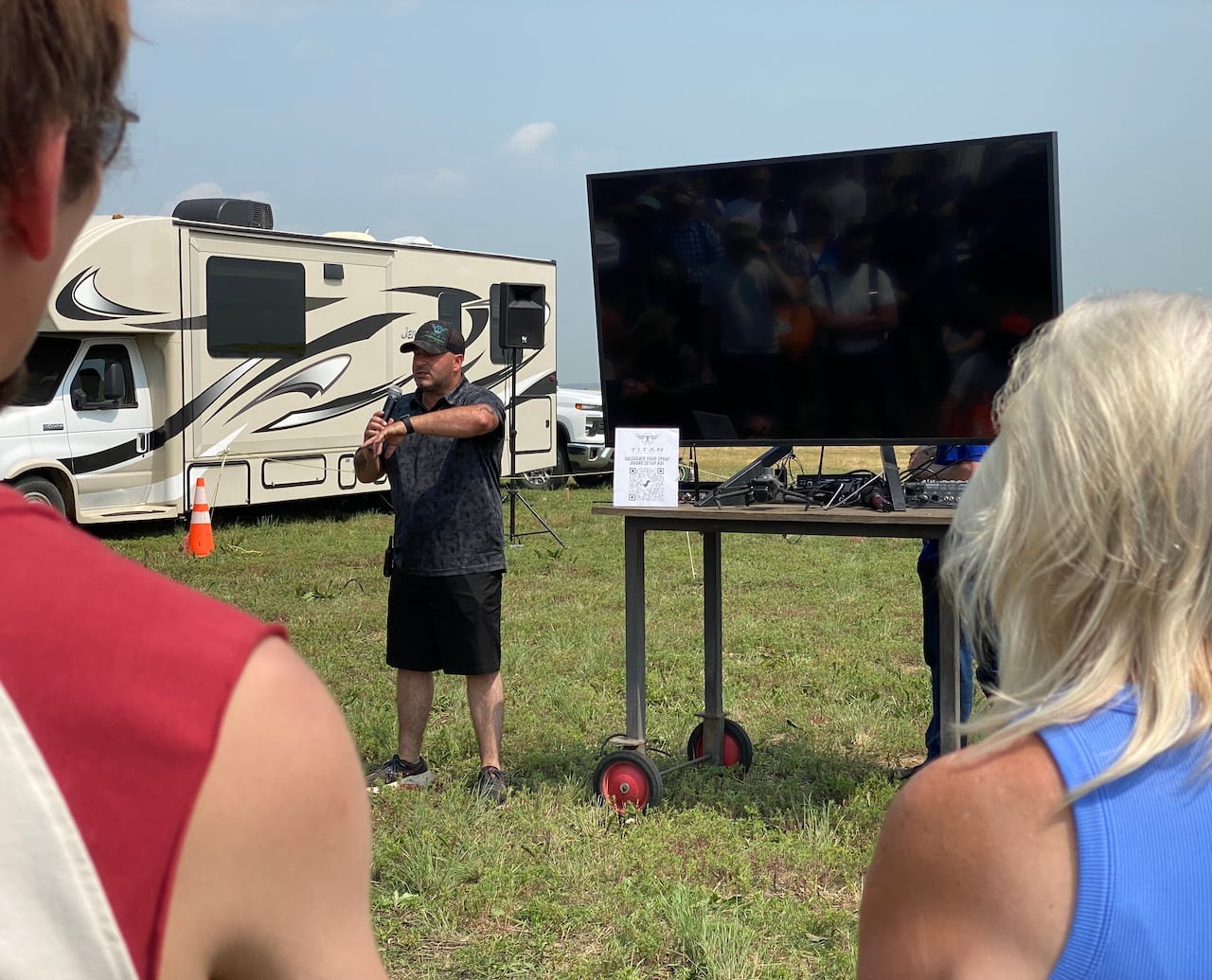
Ryan Crumly, a salesman for Titan Aero Drones, addresses attendees of the Ag In Motion convention regarding spray drones on July 22, 2026, in Langham, Sask. (Maia Tustonic/CBC)
He highlighted that while ground sprayers, even with narrow tires, can damage 22 to 24 acres of crops during operation, which could result in nearly $15,000 in losses for canola crops, drones would eliminate this concern.
“The drone pays for itself quickly,” Hill noted.
How quick will the uptake be?
Spray drones can be priced in the tens of thousands of dollars, but this is relatively inexpensive compared to ground sprayers, which can reach costs in the hundreds of thousands, according to Crumly.
Furthermore, operational expenses are lower as well — approximately 83 cents per acre for drone use, contrasted with $10.50 per acre for a high-clearance ground sprayer.
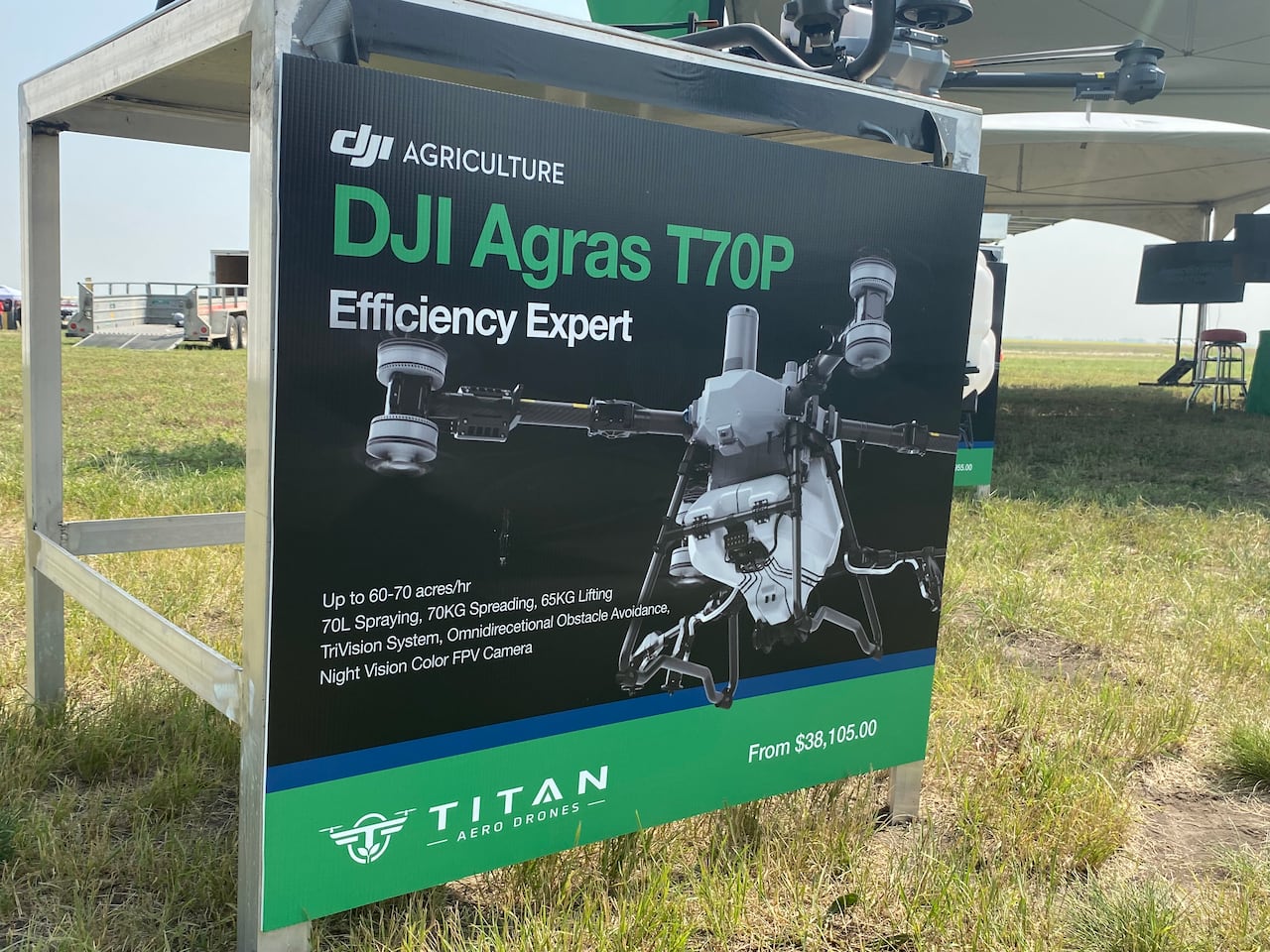
A poster displays a spray drone at the Ag In Motion convention in Langham, Sask., on July 22, 2026, indicating that prices for the drone start above $38,000. (Maia Tustonic/CBC)
However, farmers are not overlooking the initial investment costs.
“My primary concern is that my checking account isn’t large enough yet,” Hill admitted.
Although he stated that drones represent “the future of agriculture,” Hill believes that the technology may still require refinement in terms of covering larger areas. Nevertheless, he is seriously contemplating a purchase.
-
2 Sask. research farms slated to close will now stay open
-
Sask. farmers long for warmer days as crops suffer from severe weather
Raymond Phillips, who operates a farm located in Alberta near Lloydminster, is also monitoring the advancements in this technology. He is aware of the potential expenses beyond the initial purchase, he noted.
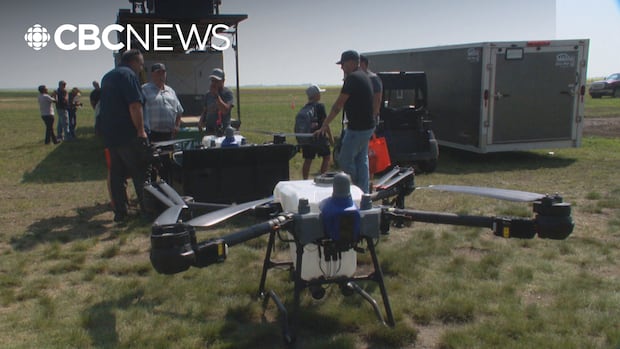
Health Canada lifted its restrictions to allow drones to spray pesticides at the end of June. Since then, dealers and farmers say there’s been a surge of interest in the technology.
“You need a mixing system, a generator, and a pilot’s license,” he pointed out. “There are many components to consider before deciding to make a purchase today.”
Still, Phillips envisions acquiring one within the next two to three years.
“They are still evolving,” he stated. “But I believe it is an inevitable trend.”

