
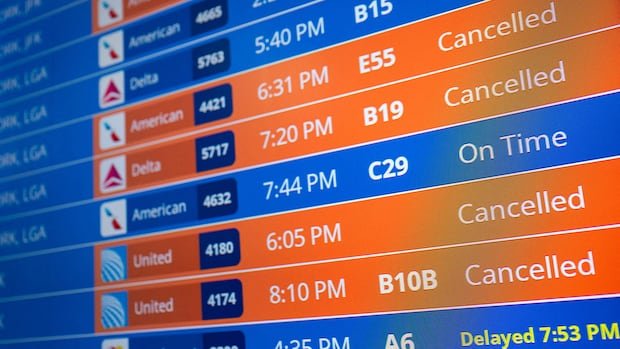
A critical situation is unfolding at airports nationwide in the United States, with escalating challenges anticipated this week should Congress fail to resolve the federal government shutdown. U.S. airlines were compelled to ax over 1,500 flights on Saturday and over 2,900 on Sunday following a directive from the Federal Aviation Administration (FAA) to alleviate air traffic congestion due to absent air traffic controllers who have not received pay for nearly a month.
As of early Monday, airlines had already scrapped nearly 1,600 flights for Monday and close to 1,000 for Tuesday. The ongoing situation marked the fourth consecutive day with flight cancellations surpassing 1,000, with a November winter storm in Chicago further complicating air travel disruptions.
While the Senate took an initial step toward ending the shutdown on Sunday, final approval may take several days, and aviation experts suggest that even after the government reopens, it will take time for flight operations to normalize. Delays and cancellations are becoming more pronounced at various airports, including Newark, Orlando, Chicago, and Detroit, with departure delays exceeding an hour and growing, according to FlightAware.
The ongoing shutdown has deprived air traffic controllers of two pay periods, prompting Nick Daniels, the head of the air traffic controllers union, to hold a news conference to address the adverse effects of the shutdown on their workforce. The shortage of air traffic controllers has led to a mandatory reduction in flights by the FAA, starting at four percent over the weekend, expected to increase to six percent on Tuesday and ten percent by the upcoming weekend. U.S. Transportation Secretary Sean Duffy indicated the potential need for additional flight cuts up to 20 percent due to the declining controller attendance.
The shortage of air traffic controllers, a longstanding issue, has been aggravated by the shutdown, prompting an acceleration of retirements among controllers. The flight reductions, though seemingly minor at four percent, are predominantly affecting 40 of the busiest and most congested airports across the nation, as controllers face prolonged work hours and mandatory overtime amid the funding crisis. If left unaddressed, the situation could deteriorate further as the U.S. approaches the bustling holiday travel season, potentially leading to a substantial decrease in air travel by the week of American Thanksgiving.

