
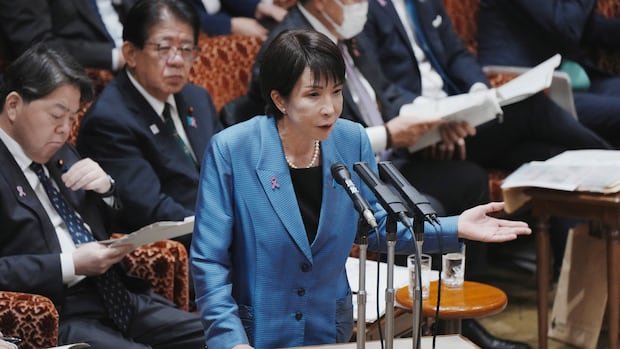
Japan has issued a warning to its citizens in China to heighten safety measures and steer clear of crowded areas due to escalating tensions between the two largest economies in Asia over Japanese Prime Minister Sanae Takaichi’s remarks regarding Taiwan. Takaichi sparked a significant diplomatic clash by suggesting that a Chinese attack on Taiwan, posing a threat to Japan’s survival, could trigger a military response.
This dispute has the potential to negatively impact Japan’s economy, as Beijing has advised its citizens against traveling to Japan. Chinese tourists make up a significant portion of all visitors to Japan, accounting for nearly a quarter of the total. Consequently, tourism-related stocks in Japan experienced a sharp decline in response to this news.
In efforts to alleviate the tension, a senior Japanese official engaged in discussions with his Chinese counterpart in Beijing. However, a breakthrough in the situation did not seem imminent. Takaichi’s comments were notably more direct than those of her predecessors, who had expressed concerns about China’s stance on Taiwan but had not publicly outlined Japan’s potential response.
The Chinese Foreign Ministry has urged for a retraction of Takaichi’s statements, but Japan’s top government spokesperson, Minoru Kihara, indicated that Tokyo was not inclined to do so. Kihara emphasized that the government’s stance remained unchanged and expressed hope for a peaceful resolution through dialogue on Taiwan-related issues.
Amidst the escalating tensions, film distributors in China have suspended the screening of at least two Japanese films, reflecting deteriorating domestic sentiment. Additionally, the screening of several upcoming Japanese films, including “Crayon Shin-chan the Movie: Super Hot! Scorching Kasukabe Dancers” and “Cells at Work!” in mainland China, has been postponed.
Apart from the tourism sector, Japan heavily relies on China for the supply of crucial minerals used in various industries, from electronics to automotive manufacturing. Japan’s economic security minister, Kimi Onoda, emphasized the risks associated with economic dependency on a country that resorts to economic coercion. Responding to China’s travel advisory for its citizens, Onoda highlighted the dangers of such economic reliance.
Trade Minister Ryosei Akazawa noted that there have been no significant changes in China’s export control measures on rare earths and other materials. In a bid to address the diplomatic tensions, the heads of Japan’s three business federations met with Takaichi to advocate for dialogue as a means of resolving the situation.
The geopolitical significance of Taiwan, being close to Japanese territory and a crucial sea route for Tokyo’s trade, underscores the complexity of the escalating tensions between China and Japan. Moreover, the presence of the largest U.S. military contingent overseas in Japan further adds to the intricacies of the situation.
Notably, Chinese coast guard ships recently navigated through waters surrounding a group of East China Sea islands claimed by both Japan and China. While the United States does not formally recognize Japan’s sovereignty over these islands, it has reiterated its commitment to defend them under the Japan-U.S. security treaty in case of an attack.
In response to the U.S. ambassador’s assurances, a Chinese Foreign Ministry spokesperson dismissed them as a “political show with ulterior motives.” The ongoing developments highlight the complex dynamics and potential ramifications of the diplomatic tensions between China, Japan, and the United States.

