
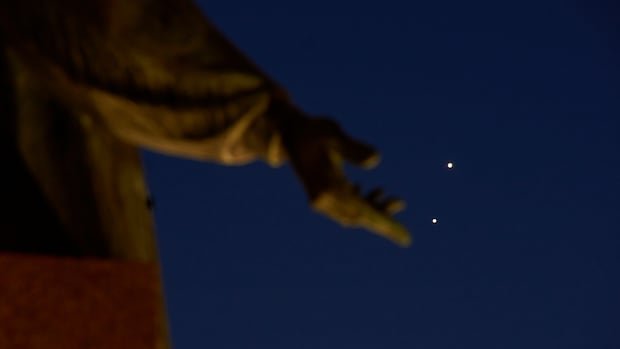
In the evening sky, two bright celestial bodies catching the eye are not stars but the planets Jupiter and Venus, set for a striking rendezvous soon. Despite their close appearance, Jupiter and Venus are actually quite distant from each other, around 670 million kilometers apart. Venus has been steadily climbing in the sky since early May, while Jupiter has been descending towards the western horizon.
Observing the skies after sunset, you can spot Jupiter and Venus in the west, with Venus shining brighter and positioned lower on the horizon. This celestial conjunction serves as a vivid demonstration that the cosmos is in constant motion. According to Paul Delaney, an esteemed professor at York University’s Department of Physics and Astronomy, these two prominent planets in the evening sky offer a captivating sight and a convenient opportunity for naked-eye observation, showcasing the dynamic nature of our solar system.
As the days progress, Venus will surpass Jupiter, appearing higher in the sky. On June 8, they will be slightly over a degree apart, drawing even closer on June 9. Such celestial encounters are technically termed appulses but are commonly referred to as conjunctions. You don’t have to wait for their closest approach to each other; instead, you can monitor their movement across the sky over the upcoming days with a clear view of the western horizon.
Additionally, Mercury will join the planetary pair on June 8 and 9, rising above the sun’s glare. Delaney pointed out that planetary conjunctions occur annually, with varying proximities and visibility. While Jupiter and Venus align approximately every three years, not all such encounters are visible in the evening sky.
For a fascinating prelude to the conjunction, observing Jupiter’s moons can be an engaging activity. Jupiter’s four brightest moons – Io, Callisto, Europa, and Ganymede – orbit the planet rapidly, allowing their positions to change noticeably from one night to the next. By tracking their movements, you can witness these moons shifting positions relative to Jupiter, offering a captivating celestial spectacle that can be further enhanced with tools like Sky & Telescope’s Jupiter Moons tool or astronomy apps for sky object identification.

