
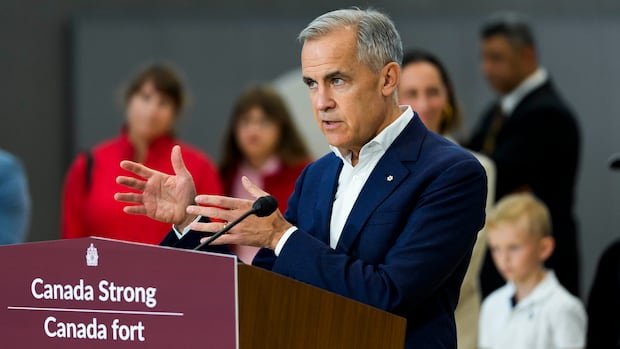
Prime Minister Mark Carney indicated on Friday that the future of the emissions cap imposed on oil and gas producers hinges on broader initiatives to reduce emissions. This signals a potential departure from his earlier commitment to the policy. During a press briefing in Ottawa, Carney responded to inquiries about the possibility of scrapping the cap and the tanker ban along the B.C. coast, measures that the oil and gas industry and the Alberta government have urged Ottawa to revoke.
Carney emphasized that the decision regarding the emissions cap is contingent on various factors and the government’s objective of decreasing emissions from the energy, mining, and manufacturing sectors to enhance their global competitiveness. He underscored the government’s focus on achieving tangible outcomes rather than merely setting objectives.
In March, Carney had assured reporters that he would uphold the emissions cap while also expressing a desire to explore alternative methods to reduce emissions. The emissions cap, slated to come into effect in 2030, mandates upstream oil and gas operations to lower their emissions by 35% below the 2019 levels. This regulation was delayed by two years, with Ottawa introducing draft regulations last year.
Canada has committed, under the Paris climate accord, to reducing emissions by at least 40% below the 2005 levels by 2030. Carney and his team have evaded questions regarding this target, instead emphasizing Canada’s aim to achieve net-zero emissions by 2050. The emissions cap forms a crucial part of Canada’s strategy to meet these objectives, particularly as the oil and gas sector contributes around 30% of the country’s total greenhouse gas emissions.
Recent reports suggest that Canada is falling short of meeting its 2030 emission reduction targets, with emissions presently standing at approximately 8.5% lower than the 2005 levels. Carney revealed ongoing discussions with Alberta Premier Danielle Smith regarding a potential “grand bargain.” This agreement would link Alberta’s aspiration for a pipeline to the British Columbia coast with the completion of the Pathways Alliance carbon capture project.
When asked about supporting a new pipeline to the West Coast, Carney emphasized the government’s backing for nation-building projects, including traditional energy ventures, provided they offer substantial economic advantages, align with climate goals, and benefit Indigenous communities. Industry leaders, including Enbridge CEO Greg Ebel, have voiced concerns that no pipeline project would be viable as long as the emissions cap and tanker ban remain in place.
The debate has been further complicated by tensions between Alberta’s conservative leadership and British Columbia’s NDP Premier David Eby. Eby has cautioned that repealing the tanker ban could jeopardize community backing and the social license needed for other coastal projects to proceed. Smith has criticized Eby’s remarks as “un-Canadian and unconstitutional.”
The issue of potential future pipeline projects was raised in the Senate, with Energy and Natural Resources Minister Tim Hodgson facing scrutiny over Ottawa’s stance on advancing pipeline initiatives. Hodgson emphasized the need for support from the jurisdiction where a project is located and highlighted the necessity for Alberta to secure B.C.’s cooperation for any pipeline construction.
Carney also discussed the possibility of reviving the Keystone XL pipeline during his meeting with U.S. President Donald Trump, proposing this in exchange for relief for Canada’s steel and aluminum sectors. However, critics argue that hurdles remain for the Keystone XL plan if the government maintains its stance on the emissions cap. Conservative MP Andrew Scheer emphasized the importance of not just constructing pipelines but also ensuring their utilization.

