
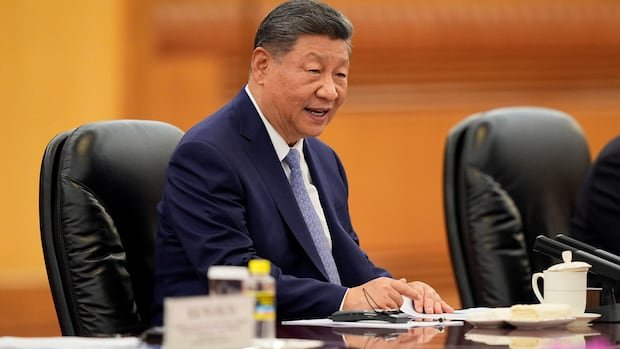
Prime Minister Mark Carney expressed his intention to reshape the dynamics of Canada’s interactions with China during his upcoming meeting with President Xi Jinping at the Asia-Pacific Economic Cooperation (APEC) summit in South Korea. This encounter marks the first direct engagement between the leaders of both nations since tensions escalated following the 2018 arrest of Huawei executive Meng Wanzhou. In response to Meng’s arrest, China detained two Canadians, Michael Kovrig and Michael Spavor.
Carney officially confirmed the meeting during discussions with journalists at the conclusion of the ASEAN summit in Kuala Lumpur, Malaysia. He described the meeting as the beginning of a broader dialogue, referring to his recent discussion with Chinese Premier Li Qiang at the UN General Assembly.
The agenda for the discussions encompasses a wide array of topics, including the commercial ties between the countries and the evolution of the global system. Carney expressed anticipation for his meeting with President Xi, emphasizing the potential for constructive engagement.
In a separate development, U.S. President Donald Trump is looking to convene with President Xi following the announcement of a framework for a potential trade agreement between the two nations. Carney hinted at the possibility of relaxing investment restrictions on Chinese capital that were imposed by the previous Liberal government under former Prime Minister Justin Trudeau. Additionally, Carney indicated a willingness to explore a free trade agreement with the Chinese government or to lift tariffs on Chinese electric vehicles that were imposed in 2024, mirroring actions taken by the United States.
Carney underscored the significance of rebuilding relationships over time, particularly after experiencing downturns. He highlighted China’s position as Canada’s second-largest trading partner, the world’s second-largest economy, and one of the most influential global players.
The most recent formal meeting between a Canadian prime minister and President Xi occurred in 2017, where attempts to secure a trade deal fell through under the Trudeau administration. Subsequent events, including the arrest of Meng and the detention of Canadian citizens, strained bilateral relations further. Recent retaliatory measures by Beijing in response to Canadian tariffs have exacerbated tensions, including sanctions and duties on Canadian exports such as canola seed.
Carney acknowledged the current low point in relations but expressed optimism about the potential for substantial improvement moving forward.

