
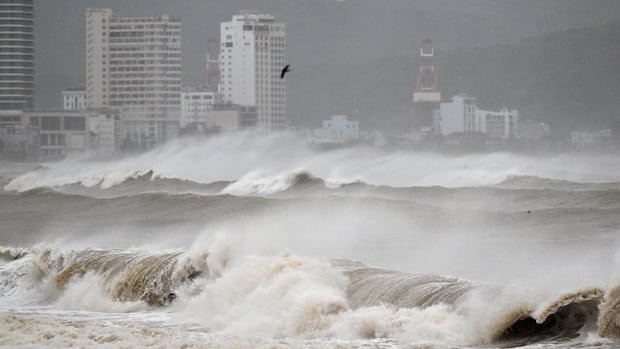
Typhoon Kalmaegi made landfall in Vietnam on Thursday, leading to the suspension of numerous flights and issuance of stay-at-home orders, following its recent rampage through the Philippines, where it claimed the lives of at least 114 individuals. Packing winds reaching speeds of up to 149 kilometers per hour, the typhoon caused significant damage, including the tearing off of roofs, toppling of trees and telegraph poles, and generating waves soaring up to 10 meters (30 feet) along the central coast.
Authorities shut down six airports and evacuated over 260,000 residents in Gia Lai province to ensure their safety. This marks the 13th storm to hit Vietnam this year, ranking among the most severe ones. The government mobilized more than 268,000 soldiers for potential search and rescue missions, anticipating flooding in low-lying areas and potential agricultural disruptions in key regions like the Central Highlands, renowned for coffee production.
Ahead of the storm’s arrival, preparations were in full swing with the closure of establishments along Cua Dai beach near the historic town of Hoi An. Meanwhile, in the vicinity of Hue, farmers were still grappling with the aftermath of recent floods that claimed the lives of 47 individuals. Among them, rice farmer Nguyen Van Rin shared his concerns about the impending calamity, having already experienced multiple flood episodes that devastated his livestock and poultry.
Vietnam’s aviation authorities issued alerts for possible disruptions at eight airports, including Da Nang International Airport, urging airlines and local officials to closely monitor the storm’s trajectory for passenger safety. Notably, Hoi An and Hue were already in recovery mode following last week’s flooding, which resulted in the loss of at least 35 lives.
In the Philippines, the impact of Typhoon Kalmaegi was severe, affecting nearly two million people and displacing over 560,000 individuals, with around 450,000 seeking refuge in emergency shelters. President Ferdinand Marcos Jr. declared a state of emergency in response to the crisis. The province of Cebu bore the brunt of the devastation, with homes destroyed, vehicles overturned, and streets strewn with debris as floodwaters receded.
Over 200,000 residents were evacuated in anticipation of the typhoon’s landfall, with many returning to find their dwellings in ruins. The arduous task of cleanup and debris removal commenced, essential for facilitating relief efforts and ensuring the safety of affected communities. The recent calamity compounded the challenges faced by Filipinos, coming shortly after a powerful earthquake struck Cebu, claiming lives and displacing numerous families.
As Typhoon Kalmaegi exited the Philippine area of responsibility, meteorologists monitored a developing storm east of Mindanao that could intensify into a typhoon, raising concerns for potential repercussions in the coming days. The aftermath of Kalmaegi, the 20th storm to hit the Philippines this year, underscores the resilience of communities grappling with successive natural disasters, including the recent earthquake that struck northern Cebu, further straining resources and resilience.

