
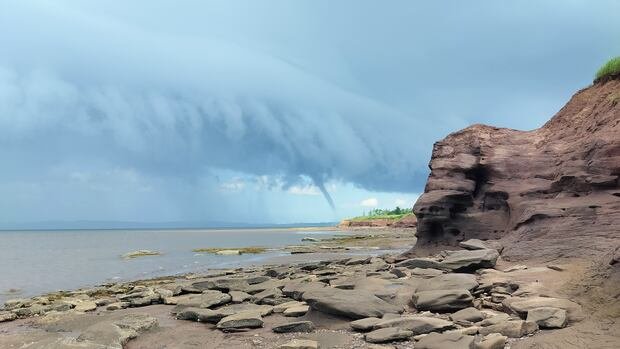
Laura MacNeil has operated shoreline excursions in the Vernon Bridge region of Prince Edward Island for six years. While her usual tours focus on the island’s fossil sites and ancient history, MacNeil’s group encountered a unique natural spectacle on Saturday morning.
Noticing dark clouds in the distance, MacNeil hurried her group back to avoid an oncoming downpour. As they rounded a cliff, she spotted a waterspout in the distance. Following its dissipation, a second waterspout emerged further out, approximately one to two kilometers from the shore.
Expressing her excitement, MacNeil described the experience as thrilling and remarkable. The Northern Tornadoes Project, a research group monitoring severe weather in Canada, confirmed the occurrence as a waterspout-tornado. Classified as an “EF0-Default” on the Enhanced Fujita scale, the tornado did not cause any structural damage.
Dave Sills, the director of the Northern Tornadoes Project, mentioned the rarity of detecting such weak tornadoes like this one and emphasized the potential for damage had it made landfall. Unlike traditional tornadoes, waterspouts and landspouts are usually weaker and shorter-lived due to their distinct formation mechanisms.
Witnessing the tornado while driving between Belfast and Orwell, Josh Coles observed its growth and dissipation over a five-minute period. Coles expressed amazement at the sudden transformation from heavy rain to clear skies after the tornado vanished.
Reflecting on the event, MacNeil recalled witnessing waterspouts off the south shore of P.E.I. two decades ago but noted the recent sighting as the closest encounter with tornado-like cyclones. She described it as one of the most memorable tours she has conducted.

