
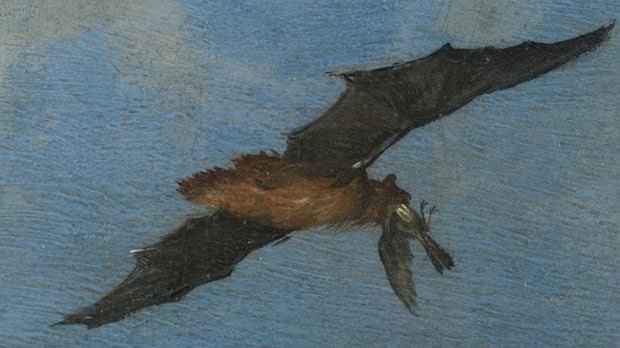
Europe’s largest bat has been found to possess a remarkable ability: catching and consuming birds while in flight. This behavior, observed by researchers last year, has now been further supported by evidence hidden in a painting created by 17th-century Flemish artist Jan Brueghel the Elder over 400 years ago.
In a recent publication in the journal Proceedings of the National Academy of Sciences, ecologists unveiled the discovery that a painting titled “Air” by Brueghel showcases a large noctule bat grasping a seemingly lifeless songbird in its jaws. Miguel Clavero, an ecologist with the Spanish National Research Council and one of the study’s co-authors, stumbled upon this finding while attempting to document all animals depicted in the painting.
Consulting with a bat expert, Clavero and his colleagues confirmed the presence of a greater noctule bat engaged in bird consumption. The researchers’ interest in this behavior dates back to 2001 when they first noticed bird feathers in bat feces, indicating a preference for larger prey by the bats.
Through modern technology involving equipping bats with tracking devices, scientists were able to validate the existence of this behavior. The painting by Brueghel, with its detailed portrayal of bats consuming birds, provided a surprising historical correlation to the scientists’ findings.
Although the exact source of Brueghel’s knowledge remains uncertain, experts believe it could have been inspired by real natural-history observations. While some suggest the painting may have been purely artistic imagination, the potential for historical art to reveal hidden insights into wildlife remains a fascinating prospect.
The significance of this discovery extends beyond the depiction of a bird-eating bat centuries ago. It prompts a reconsideration of historical biodiversity and the potential for further revelations within artistic and historical records. The exploration of such sources may lead to additional surprises regarding the natural world that have long been overlooked.

