
Adriana Avelina Ruíz Márquez employs false eyelash adhesive to affix a miniature transmitter to the thorax of a monarch butterfly, positioned just behind its head. The monarch, weighing approximately half a gram, effortlessly carries the 60-milligram device, complete with a tiny solar panel. After the delicate procedure, which involves a toothpick and a Q-Tip, Ruíz Márquez releases the butterfly, observing as it flutters its wings and takes flight. This innovative tracking device, a first-time application in Mexico for tagging monarchs before their migration back to the U.S. and southern Canada, is expected to unveil mysteries surrounding the insects’ behaviors and movements, leveraging smartphones for tracking assistance.
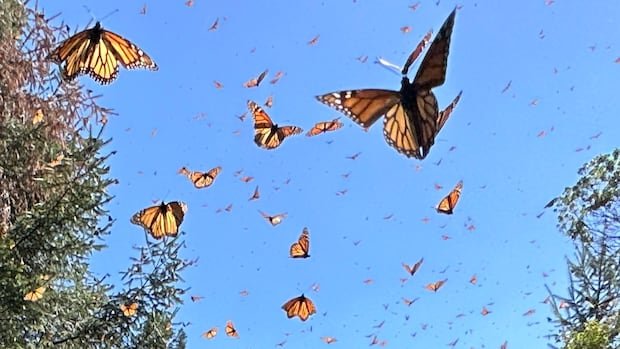
In the El Rosario butterfly sanctuary, where sunlight filters through the towering oyamel firs, countless butterflies swirl akin to the density of mosquitos and blackflies at Canadian marshland dusks. This sanctuary, located in Michoacán, serves as a winter haven for the majority of North America’s monarchs east of the Rocky Mountains. As part of the Monarch Butterfly Biosphere Reserve, spanning Michoacán and the State of Mexico, this sanctuary covers a protected area of approximately 135 square kilometers.
Teams from the federal Commission for National Natural Protected Areas and the World Wildlife Fund (WWF) Mexico have tagged a total of 160 monarchs across the reserve with the new transmitters, with El Rosario hosting 40 of these tagged butterflies. This initiative aims to provide detailed insights into the initial phase of the monarchs’ migration northward. Eduardo Rendón Salinas, a biologist with WWF Mexico, emphasizes the importance of tracking monarchs between colonies, a concept previously only theoretical.
The unique migration pattern of the monarch butterfly involves three to four generations to complete the journey northward, spanning up to 5,000 kilometers. The “super generation” emerges in late summer, embarking on a continuous journey southward from the Prairies to the Maritimes, through the U.S. Northeast and Midwest, before returning north after mating in sanctuaries like El Rosario. This annual two-way migration, exclusive to the monarch butterfly, is a natural marvel.
The microchipped transmitter emits signals detectable by nearby iPhones, enabling crowd-sourced tracking of the butterflies’ trajectory if Bluetooth and location functions are activated. The Project Monarch app and handheld receivers can aid in mapping the butterflies’ movements, offering unprecedented spatial detail previously unattainable. David La Puma, from Cellular Tracking Technologies, the device developer, highlights the enhanced tracking capabilities compared to traditional wing tags, with plans for Android smartphone compatibility in the future.
Following successful pilot programs in 2023 and 2024, the transmitters were integrated into a continent-wide monarch tracking initiative involving over 20 groups. By October, 400 monarchs from Canada to Cuba had been tagged, tracing their entry into Mexico’s Monarch Butterfly Biosphere Reserve in November. The El Rosario sanctuary, protected by a community patrol to ward off illegal logging, transforms into a butterfly empire between November and March, attracting a diverse array of wildlife while offering economic benefits to the local community through sustainable tourism practices.

